Serendipity goes by her own schedule. There are times in life where she graces you with her presence in regular glimmers, reminding you of the mystery and wonder that life can hold. I’ve also had periods where it feels like she has, if not deserted, at least taken an extended hiatus to a distant land where she’s considering setting up permanent shop.
Whether it’s because of the nature of the place, or because I’m paying more attention these days, serendipity does seem to like to make surprise appearances in Desolation Sound. Like, this day, when I was trying to test the line from this solar panel to the new Jackery power bank that my husband got. Solar power is our life line up here. While I’m using butane for my stove and gas for my boat (another long story as we started out with a 9.5’ tender with an e-motor and I had hoped to stay electric, but it wasn’t really feasible for me to do that…yet), for all our electronics and our power tools, the sun is our source of power. Which makes Desolation Sound a little bit like a solar punk lab, testing the limits of what regular folks can do to not just survive but thrive when detached from grid power. But solar punk isn’t just about using renewable power now and then. It has to go harder. It’s punk after all. So, I’ve been thinking about what solar punk might actually look like out here.
So, back to the Jackery power bank. As I was saying, it wasn’t charging for some reason, and I saw that there was a little console on the cord where you could plug in a USB, and so I plugged in my phone to it to test it. To my surprise and delight it started charging my phone directly! “Wow!”, I thought to myself, “That is so cool! It’s like I’m plugged right into the sun. Could that be classified as solar punk?” And then, as I was thinking this thought, serendipity came along and gave me my answer…
It’s five o’clock in the morning. Do you know where your boat is?
This is the question that seeps into my mind after I roll over to check the time. I try to go back to sleep, but that’s not about to happen now that I’m thinking about the boat. So, I roll out of my sleeping bag, unzip my tent and squint down towards the sea. The air is perfectly calm, the sea is glass, the birds are starting to serenade the day, and my boat is totally fine. Yet, it would not be hyperbole to say that I have the boat buoy blues.
It all started on Wednesday night, when I was busy preparing my camp for at least a week of inclement weather heading in. It’s not so much the rain that concerns me out here. It’s the wind. Say you put up some lovely tarps to protect your camp from the rain? Think again. I myself have observed winds out here at much lower speeds that still feel like they come galloping in like ancient storm gods from Odin’s wild hunt, trash your tarp, rip it from its grommets one by one, and then use your tarp to trash the rest of your camp as it whips around… but that story is for another day. This one is about winds and tides.
Your Math Teacher Was Right
Imagine an isosceles triangle. Can’t do it? Don’t go to Desolation Sound and get a property and a boat because…. you could die. Or lose your boat. Or just an eye. Melodrama aside, well actually, no, I kid you not.
You know when you were back in school and teacher said you better pay attention to geometry or it could come back to bite you? Or maybe you were great at geometry, but then life got busy and you low key forgot about it? Well Desolation Sound is one of those places where geometry’s grim and nefarious teeth lurk, waiting to get you. Where? They lurk in plain sight in your boat buoy rope setup.
Beware the boatbuoyropesystem my child! The jaws that bite! The clamps that catch! Beware the jowls of the tide, and shun the ropeysnatch!
(That was Lewis Carroll’s first version of The Jabberwock, I swear.)
Whatever am I swarthygroping in the mimsycoves about?
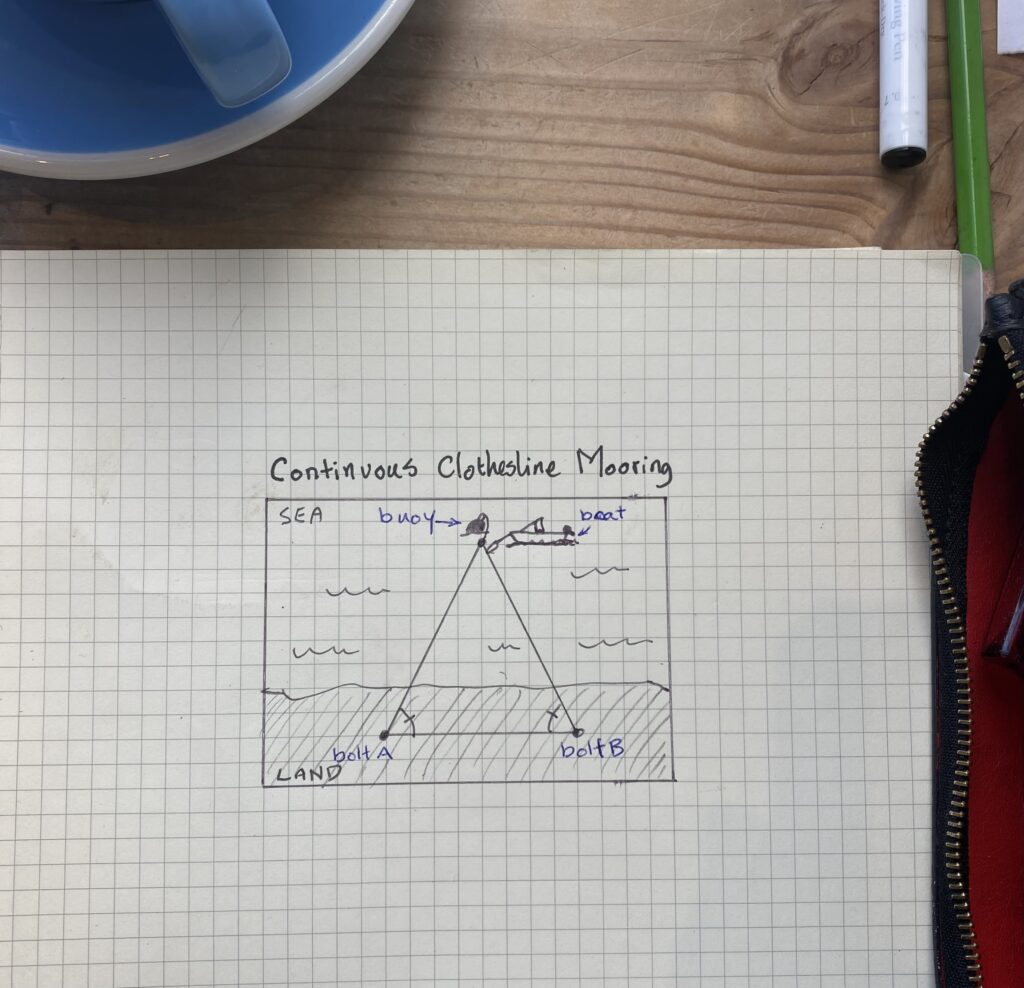
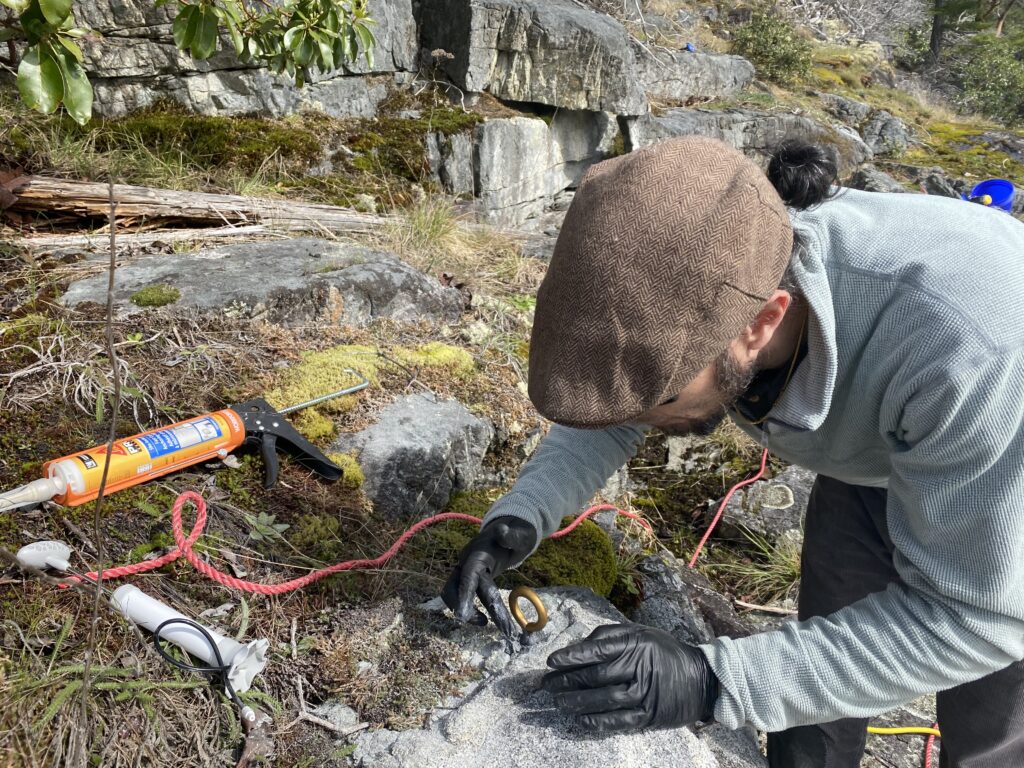
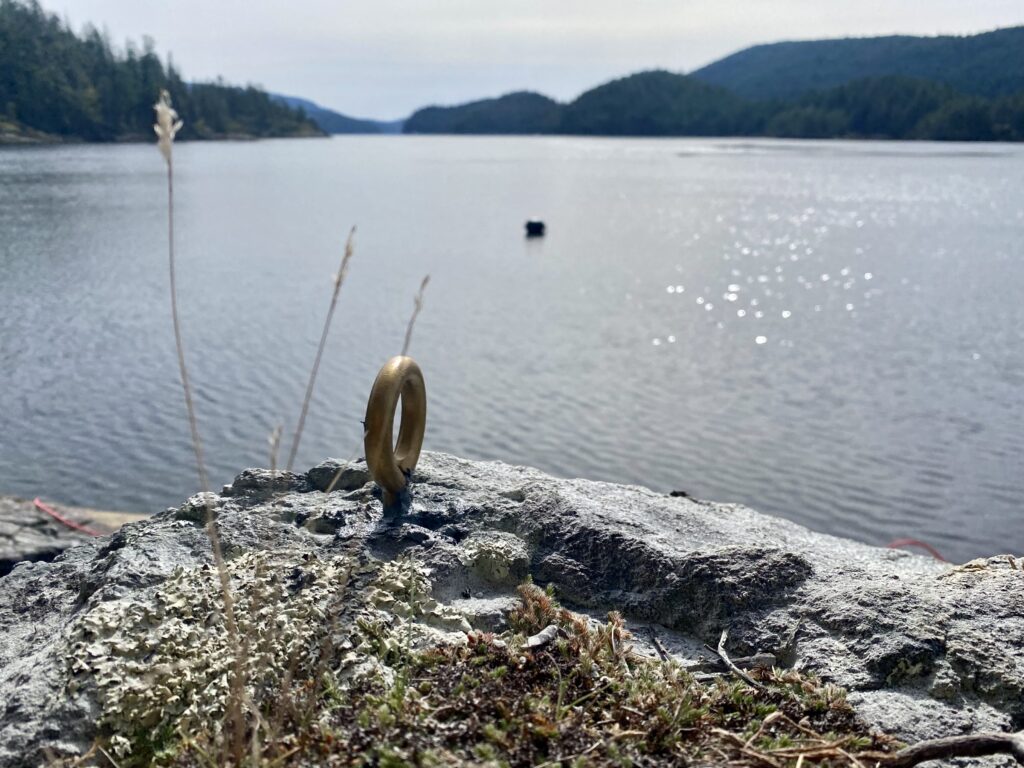
Back to our isosceles triangle. You can imagine it? Great! Now imagine the two bottom corners of the triangle are eye bolt anchors your husband (dear husband, dh) made hammer drill holes for and mounted into the bedrock. The top point of the triangle is out in the ocean—your buoy. The closest I’ve seen to a diagram of how this system works is here on this blog by Neil Moomey. So here is my own quick coffee break rendition as I sit and enjoy a few minutes in town with reliable wifi and the luxury of a lovely honey late at 32 Lakes Cafe and Bakery.
A How To Guide
This boat mooring setup is often called a “clothesline” setup or a more geeky “triple pulley boat mooring system”. It solves the problem, when all you have is a mooring buoy, of having to boat out to your boat. Instead, if all goes well, you should be able to just stand on shore and pull one rope on one side to pull your boat in and pull the other rope to send it back out to the buoy again.
Once upon a time docks were a more rare presence in Desolation Sound, and this was the going system that people used to keep their boats from being dashed upon the jagged granitic rocks that line the coasts here. But if you are not an old hand salty dawg like the folks up here and a noob at this stuff like me and my dh, there are not very many instruction guides out there for how to set up and use this system. Florida Sportsman has this Youtube video guide for the case where your land points are set into a beach. Similarly, the TheHowtoDad has a video that makes it look really easy pulling in your boat using this system on a calm day with a soft sandy beach in this video.
Let’s just say, these balmy sea bunny scenarios are NOT my use case though. While storm winds in recent years along the western shores of Vancouver Island have clocked in at 144 km/hr, here in Desolation Sound, in spite of the buffering effects of Vancouver Island and the Malaspina Peninsula, the locals inform me that the winds can similarly reach upwards of 100 km/hr, and often reach 40-65 km/hr. On the Beaufort wind scale table that covers ”near gale” through “strong gale” to “storm” categories. So, when your boat cost you your left kidney and the shore is lined with barnacle toothed boat munching rocks, you don’t want to get your mooring set up wrong. (And if it is actually going to approach Beaufort Category 7-11 conditions, many neighbours actually go and move their boats to a safer harbour or bay during that time.)
So, how do you set up a triple pulley clothesline mooring system on a rocky shore? Same in theory as the above guides, but you install your mooring buoy according to local guidelines / regs, ideally meeting and beating the buoy dead weight if you will have your boat out there in shoulder seasons. And, instead of digging into sand to mount your shore pulleys, you need to get a hammer drill and a way to cement in strong eye bolts into the bedrock at least around 20’ apart.
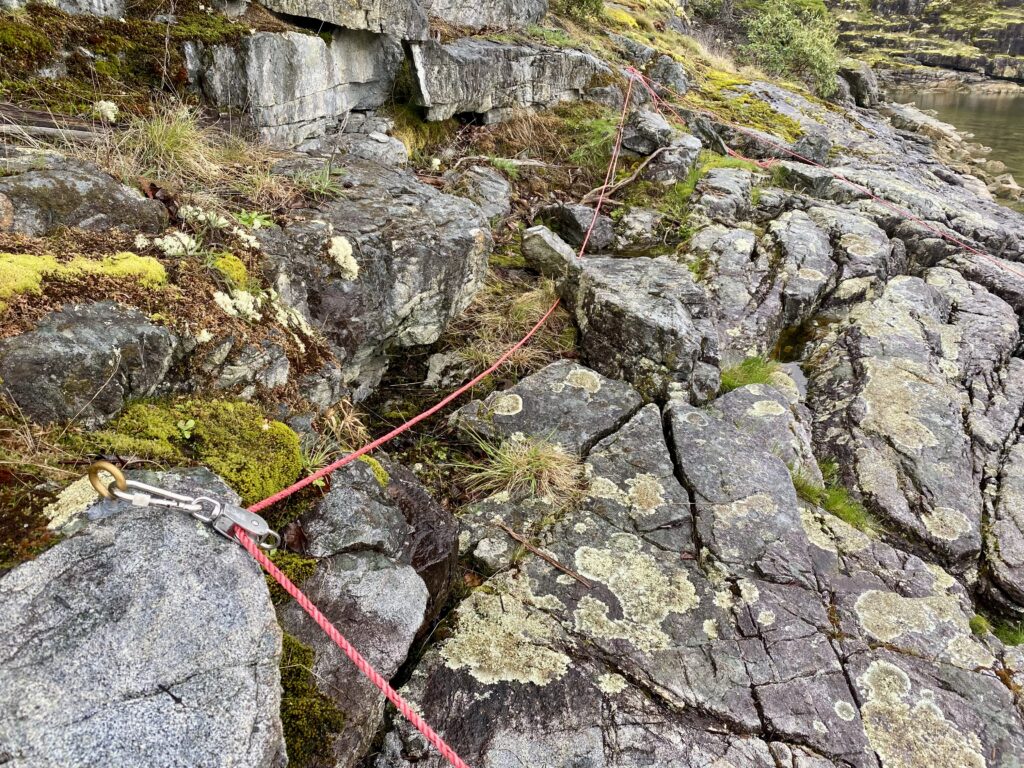
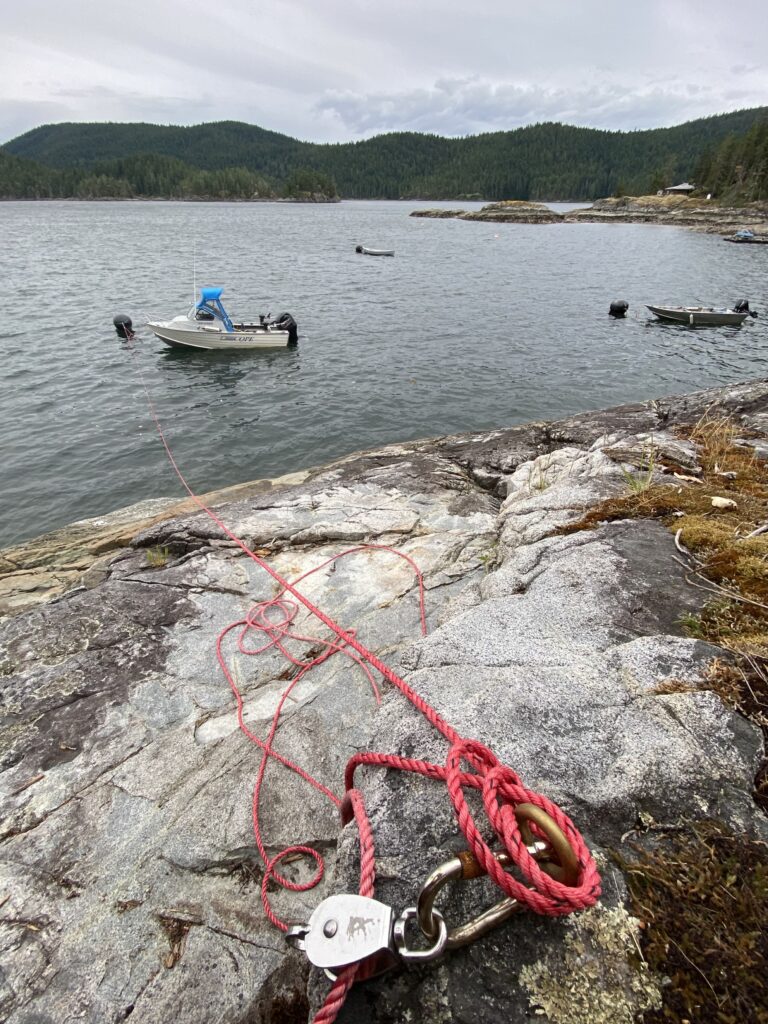
Then on each bolt, you secure a pulley and through this, connecting all three points, what many people do in these parts is string a sinking line through (so it doesn’t tangle in your propeller) and then tie it off at one of the bolts, leaving several feet of slack. (I may provide more detail on all this in a subsequent youtube video.)
A How Not to Guide
The above is the end of our seemingly simple theoretical setup. But as we all know, reality usually has other plans. It certainly had wayyy other plans for me.
One of the complications to be aware of is which side of your triangle you tie your boat up to. To do this is simple enough, you just make a loop knot on that side that you can tie a line from your bow eye to. Well, you would think it is simple from the above videos in calm conditions, but what I learned—after the wind, waves and currents picked up—is it is not.
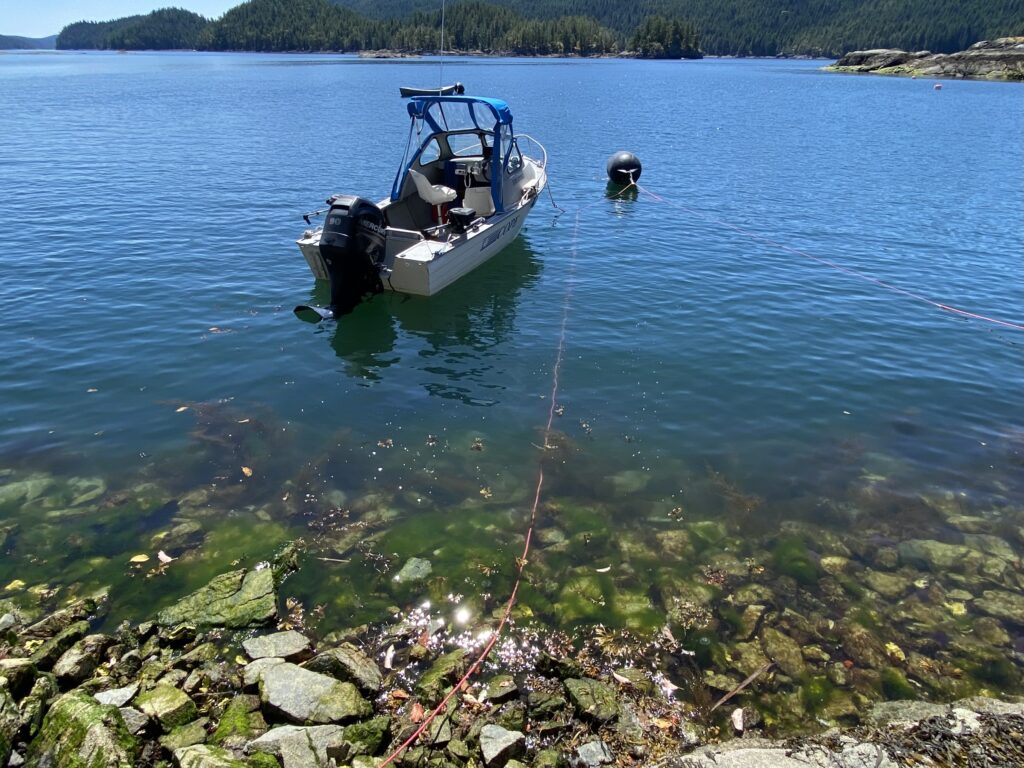
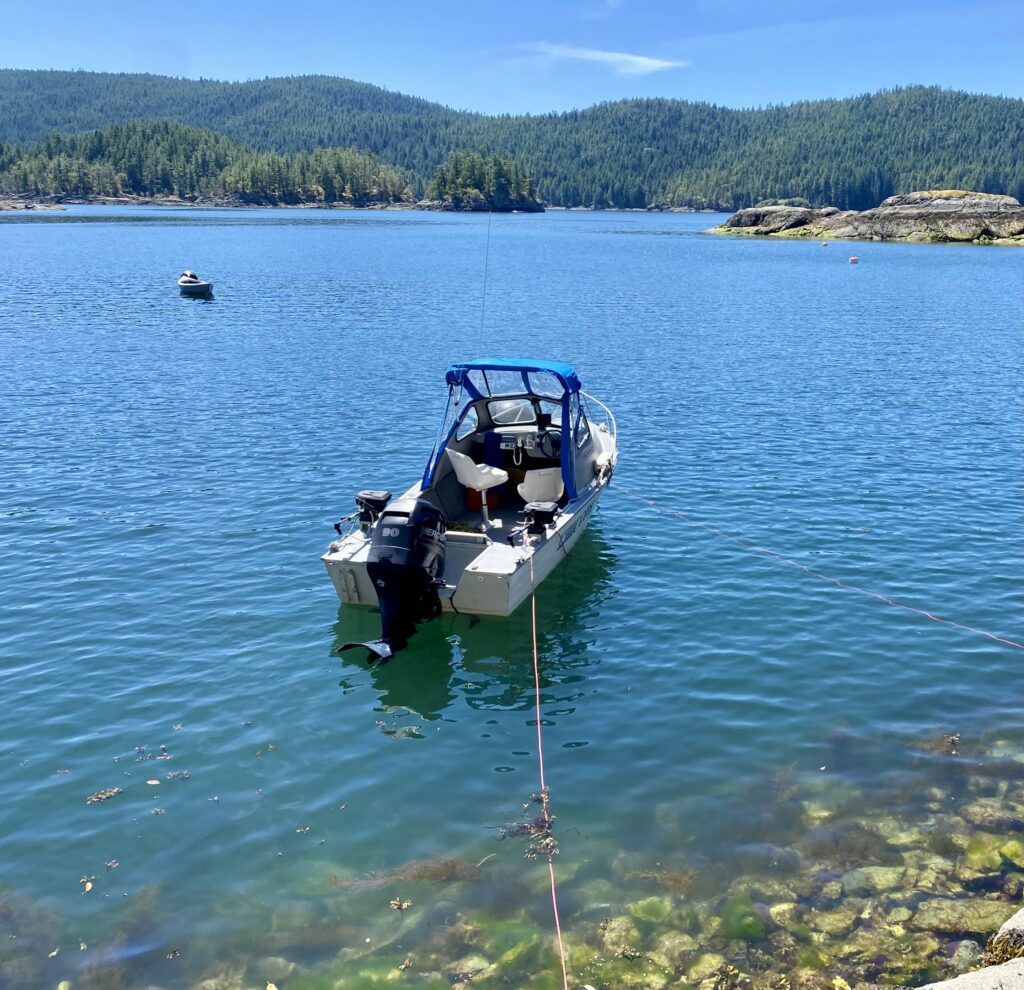
For my own measly human reasons I decided to tie my boat on the left (east) side of my clothesline triangle, and it seemed to look good after I set it up, as shown in the picture below. No twists in the lines by the buoy and my boat is positioned where I thought it would go because conditions were calm when I set this up. I arranged it to the left like this because (silly human) I thought that would keep my boat a bit farther from my neighbours’ boats that are off to the right (west). The road to hell is paved with good intentions, right?
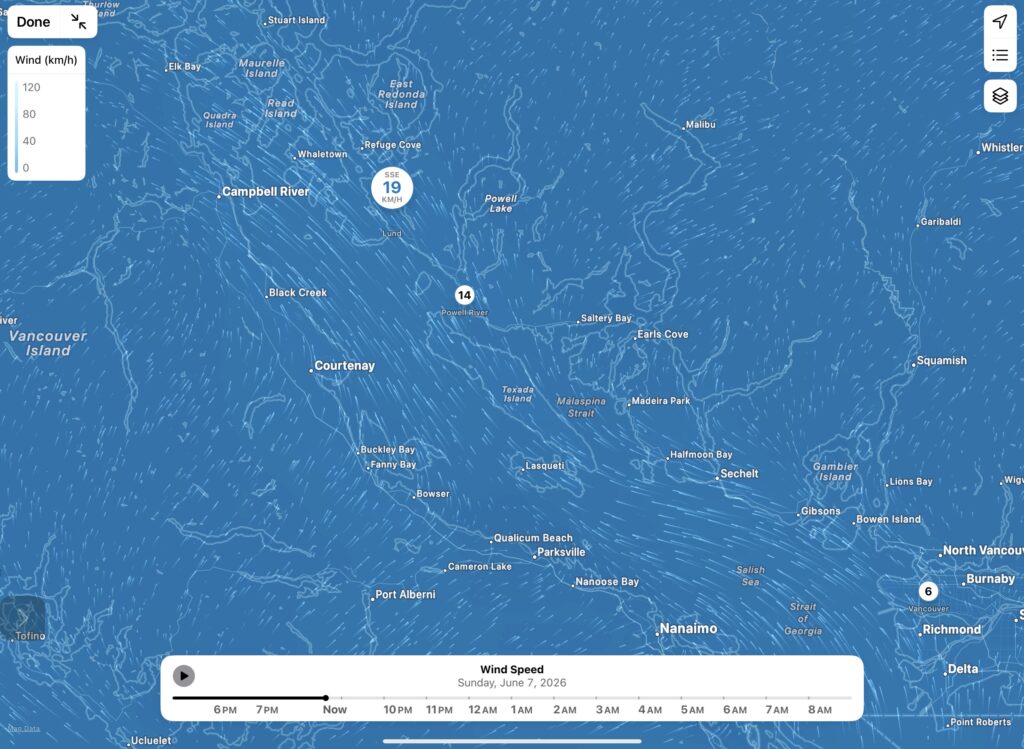
There’s nothing like the reality of the sea to fact check our best assumptions and make a mockery of our best intentions. What I realized only after I had left my boat out there for a while, and feeling proud of myself for having restrung our mooring line set up and it not twisting (again another story) was a series of lessons in humility. I had completely neglected to take into consideration the prevailing winds and currents that operate in our area. Up Okeover Inlet, and throughout the entire Salish Sea, there is a bit of a binary system most of the time. When winds are from the NW, you get calm conditions, but when that Mary Poppins wind shifts to coming from the SE, then you are in for strong winds, waves and current coming from that direction. Below is a map of the region and prevailing wind vectors showing one of these southeasterly wind scenarios where you can see all the wind vectors heading from SE up towards the NW across the Salish Sea (Georgia Strait).
Map from the iPhone weather map showing wind across the BC south coast.
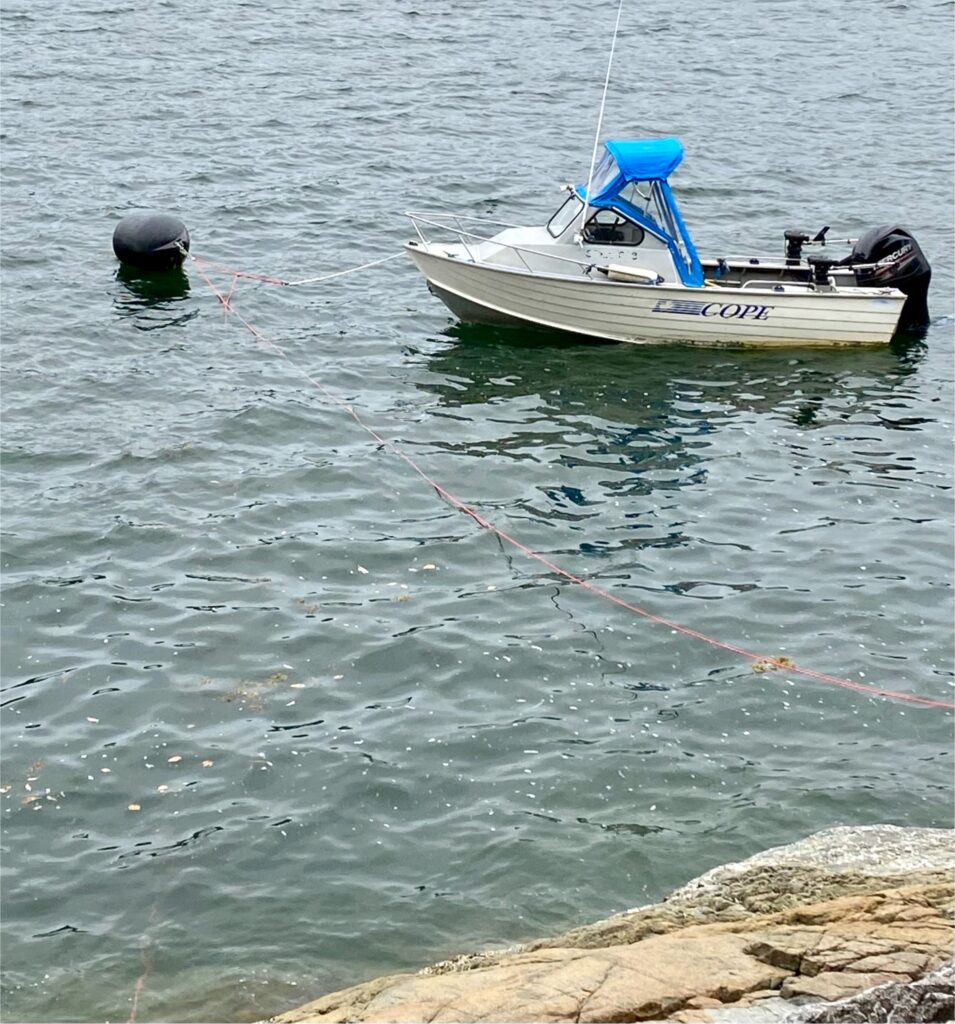
Ocean doesn’t care about your polite human preferences to not have your boat encroach on the neighbours. Ocean doesn’t care that you didn’t remember geometry or local weather systems. And out here Ocean is the boss. So, you need to know what the prevailing winds/currents are in your area to pick the best side of your triangle to tie to. If you do not, you may find yourself with a boat perpetually crossing over the other side of your triangle, looking something like this below where my boat has been pushed across to the other side and you can see by the buoy how the lines are now crossed over.
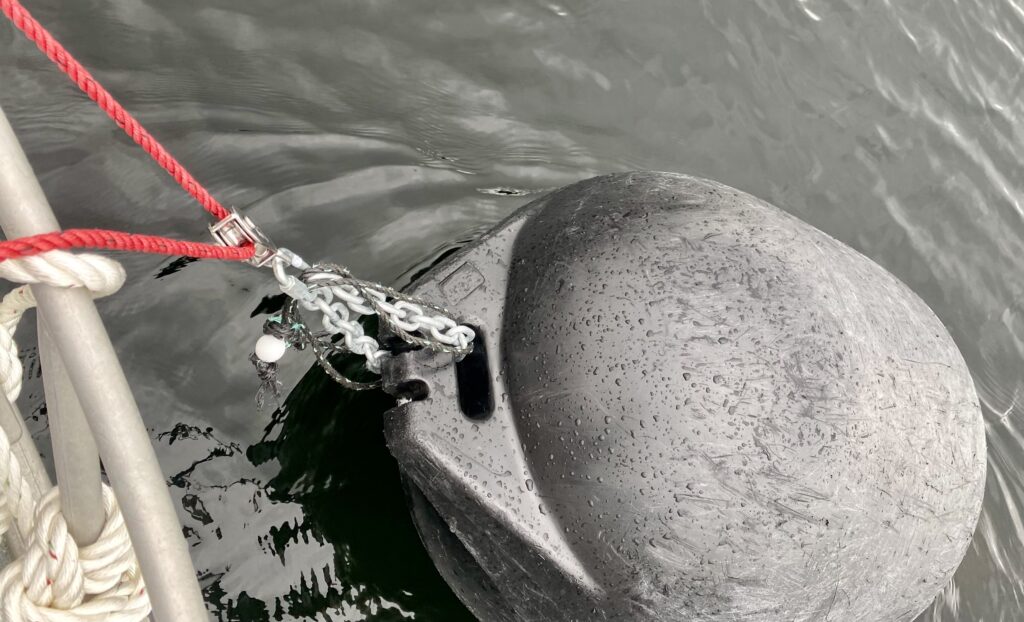
My second mistake was not tying off to the mooring line loop from my boat’s bow eye. This is a strong eye loop soldered in the bow area on the prow below the nose. My dh bought a skookum line at the local marine shop up here and it has heavy duty clamps on it, but I tied this to the mooring line loop from up on a bow cleat higher up on one side because I thought that was easier for me to access so would make my life easier, and I saw some other videos about sailboats tying to mooring buoys from up on their bow cleats. Boy, was I wrong! (My neighbour later told me to tie off to the bow eye, and I realized the error of my ways.) What ended up happening is not only did my boat wander across the other line, but because my lines were high up instead of low where the bow eye is, the lines were crossing over across the deck of my boat, and catching on all kinds of things, from the chairs, to my Scotty downriggers! Not fun watching your boat bobbing out there on the waves with the ropes all messed around, and trying to cowboy style lasso the ropes off of all your boat parts, including and especially the propeller and delicate downrigger parts. And you can’t pull it in and fix it, because the winds are high, and your boat is conceivably still safer out by the mooring buoy that pulling it into shore where the waves will instead bash the whole thing against the rocks repeatedly.
My boat with the mooring line running across the deck and wrapped around the Scotty downrigger.
My Big Mistake.
So presuming you didn’t make my first or second mistakes, now you need to shift your thinking from 2D to 3D geometry. Can you visualize what will happen to your buoy, your boat, and your ropes, as the tide comes in and goes out? No? Then bam! You’re dead. Like I almost was Wednesday night when I made a massive miscalculation.
It all started innocently and calmly enough. I had observed how my lovely neighbour who has been operating a similar system for decades made a bit of a knot in his line after pulling on it to pull his boat out to the buoy, and then looping it loosely over the eye bolt. He said you do this so that all the slack in the rope doesn’t just go out which would allow your boat too much ability to wander far from your buoy. So I copied him. And it seemed to work, no issues, for the few times that I used it. And what else did I do? Well, I had previous issues with our setup the first time we strung it up as the two ropes from shore twisted at the buoy point (due to our rope being new and wanting to twist), which made it it impossible to yank on the rope and pull the boat back in. That was extremely aggravating for my dh and I as we pulled it out, took out the loops in the rope and tried to straighten it several times before we finally got frustrated and took out the lines altogether.
So, this time I thought it would be a good idea to keep the ropes on either side fairly tight to keep the ropes pulled apart so that they wouldn’t have enough slack to twist around again. But in my general exhaustion from dealing with tarps and wind and everything else that I was going through, I didn’t think about how the tide was going to affect the length of rope needed to reach the buoy. And what I happened to do was tie up my boat at low tide, not thinking about what would happen as the tide rose…
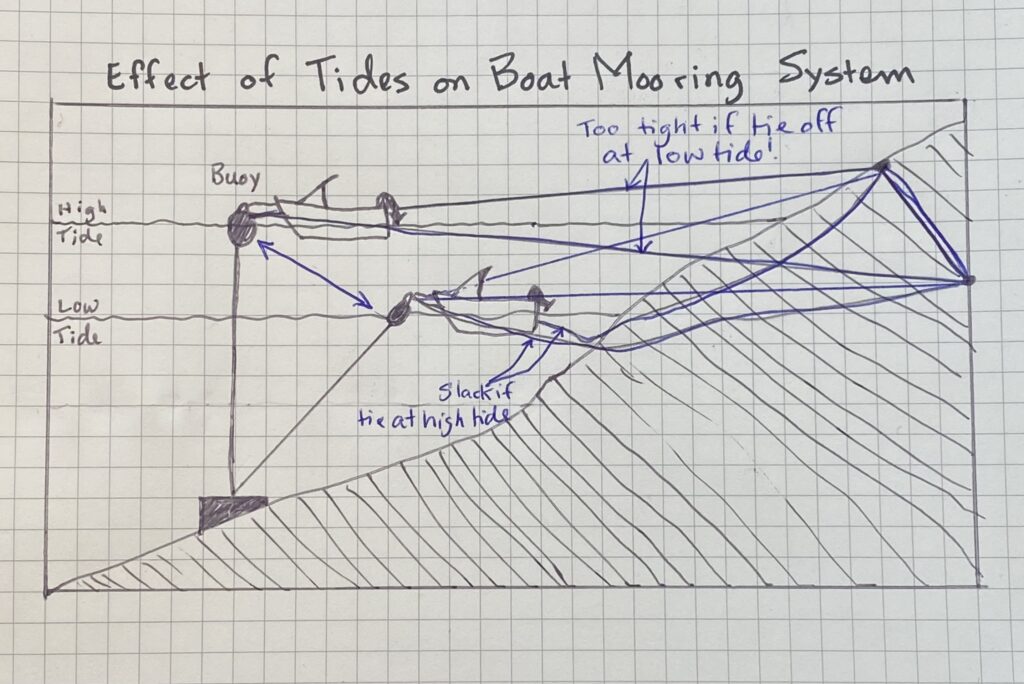
So back to our geometry review. As shown in my sketch above (sorry I only had two colours so it isn’t the clearest), what happens to the two lines of your triangle is at low tide the buoy has more freedom to swing around and can come in closer to shore, but at high tide, it is lifted straight up above its anchor. The tide does not negotiate on this. It doesn’t care if you tied off at low water and wandered off to deal with other priorities. So, in this situation, you need to be aware of what the tides are doing when you arrive with your boat and go to tie it off on shore. If it is high tide, the buoy is farthest from shore, so the lines are stretched out longer on your triangle than if you arrive at low tide.
But what did I do? I tied up my boat at low tide and I did the little knot loop to secure my ropes over both eye bolts as mentioned to prevent the lines twisting like they had done previously. Then, instead of keeping an eye on my boat and lines like a seasoned deckhand would, I got busy and distracted working on other issues in my camp. Inclement weather was rolling in and I was running around taking down some tarps and setting up others and trying to ensure that items that didn’t take kindly to getting soaked were tucked away for when the predicted rain and wind rolled in.
So then what happened? Well, the tide did what tides do. The tide went up. And up. And up…
At some point, I was all the way up at my space net location way up on a bluff, trying to string my tarp across it thinking maybe I could make a tarp room sheltered from the winds for when the rains came. I was struggling setting up our 20’ x 40’ tarp across this and trying to string up a ridge line through the middle of it. While I was working, I started hearing a clinking and clanking noise on my boat that I normally don’t hear, but I looked out at my boat and it looked OK so I kept working. Well, that sound was the clamps on the mooring line I had strung to the bow cleats banging on the boat. Not a good situation. I knew it wasn’t cool and that I had messed that up, and thought to myself that now I would now have more scratches on the paint on my second hand boat than I had before, but I figured it wasn’t dire and I could fix it when the winds dies down again. But then, there was just something about the ongoing sound of the resonating clanking sounds that kicked in some peculiar intuition in me and I had a weird feeling of danger. So, trusting my gut, I decided I better drop my current tarp predicament and go and check on the boat. Thank goodness I did that, because that’s when I discovered The Situation.
The Situation
I hiked down from the bluff and arrived on shore to a scenario I had never witnessed before and hope to never have to deal with again. What had happened was that the loops that I had put over the eye bolts had been pulled SO very tight that it was impossible for me to lift those loops back up over the circle of the eye bolt. I pulled on those ropes with all of my might, but I could not budge them. Not at all. Not one bit. And my adrenaline was rapidly mounting as I imagined scenarios where one of the anchor bolts got ripped out and took with it a part of my anatomy with it or embedded in my face or thigh, or some other wholly unpleasant outcome.
I sprung into emergency management mode that my training as a lifeguard back in the day instilled in me. Forget myself and DEAL. What did The Situation require to solve it? Pulling on the ropes like a maniac and exhausting and injuring myself in the process had not worked (you do not want to know about all the bruises). I needed to get smart, so I figured I need to use some sort of leverage to at least get one side off to give some more slack to the whole system. So then, I tried to use the big carabiner that was also on the eyebolt to lift it up to push the rope up and off. However, the way the rope was tied and the angles of the carabiner made it so that I could lift up one side of the rope or the other side, but I couldn’t get the part of the rope over the thicker diameter of the circular hole in the eye, as the rope was pulling at the base of the eye bolt as though the Leviathan itself was pulling on the other end.
I knew I could cut the lines, but I imagined it would spring out and thoughts of being whipped or impaled were not at all appealing, so I thought, Ok, I’m a human. Humans use tools. Tools got me into this situation. I needed better tools to get me out. At that point I thought about the little tool kit up near my tent that my dh had left me. I ran back up the bluff and grabbed it and found in there a strong looking larger Phillips screwdriver and a small crowbar. I was really worried that if I deployed these and managed to lever the rope over the eye bolt, that if I had one of those tools at the wrong angle when that happened that the rope would catch on this piece of metal and perhaps I would be faced with the losing a finger or an eye type hazard again. I had to risk it though, so I looked down at the tight knot I needed to deal with very carefully and figured out a way to proceed. I would use the screwdriver to lift up the rope sufficiently on one side and use the crowbar at the back to lift the rope upwards over that wider circumference of the eye screw. Then, hopefully the force vectors would pull the rope away from the back of the eye bolt towards the sea, so the crowbar would hopefully not catch and just fall back on the ground.
So at this point I was already exhausted from struggling with pulling on the ropes earlier and sprinting up and down the bluff, but I put on my safety goggles and started working on it, to try trying hard not to think of a scenario where the crowbar flew into them and embedded itself and my goggles into my eye. After struggling for a very long time and digging my knees into the granite rock and getting completely filthy dirty on the ground, trying to maneuver the screwdriver and crowbar repeatedly, I finally managed to release one of the sides! When it happened the line snapped back out towards the buoy like a bat out of hell. I ducked and blocked my face with my arms, and when I looked up again I was amazed that it had actually worked. Yes, the tools did fly a bit, but my calculations prevailed this time, and I still had all my digits and facial features.
I would have cried of happiness for having succeeded, but the side I had released was the one with the boat loop on the east side, and it was the other west side that now was bearing all the force of holding a too short rope with a buoy pulling at it with all the force of the sea. However, exhausted as I was, I was encouraged that my method had worked, and so I went over to the other side, gathered up all my remaining adrenaline, and after another very long and ugly struggle, managed to release the rope from the other side as well. Being so very strung tight, it sprung back with such a crazy force that I have never witnessed before in my life. And hope to never again.
Last Words
So here I am now on a calm and sunny day writing the last words of this blog post instead of someone else reciting the last words of my eulogy over my dearly departed self. So all you noob boaters out there who might be thinking of setting up triangle mooring systems please please please be warned and take this as a public safety message to learn from my mistakes, and never ever do what I did at home kids. Secure your line at high tide if you are going to walk away for a bit, and if it is low tide, monitor the situation with your ropes every couple of hours. It doesn’t matter if your line is new and annoyingly might twist. It doesn’t matter if high tide is at two o’clock in the morning. This is British Columbia and I am a mom, and “safety first” is wired into our Canadian identity. So, if you are tying off at lower tide also always leave a little extra slack in your lines for the tide to come up, because you know, life happens, and we are also the distracted generation. It is just not worth it to risk The Situation that happened to me.
But that isn’t all. If that is the shot, here is the chaser. If you leave too much slack in your rope when you tie it off, the other risk is at low tide your boat could wander too close to shore, and during high wind situations… Bam! Your boat is dead. Smashed on the rocks. But, at least you are intact and not dead instead. As ever in life, when it comes to boat ropes and the tides, it’s all about balance.
So when my family checked in with me after The Situation was over, I joked that I didn’t get a crowbar embedded in my eye or lose a finger that day, so it was going pretty good. And we all had a chuckle.
Such a me thing to do. Making silly mom jokes all the time. But really, it’s ok crew, I’ve really been doing fine… When I signed up for this I didn’t think it was going to be something approaching marines boot camp training, but if that is what it takes to connect to what living on the land means out here, then sign me up. Again and again. While I hope Ocean will go softer on me going forward, I’ll go through all the hazing she has to dole out for this goal, so I’m not ready to throw in the towel yet.I have learned the ropes the hard way on this one, but one of the lessons I’ve seen is that the ropes themselves are your life line out here, so I’ll be paying them more attention and care going forward.
And as I was green and carefree, famous among the barns
About the happy yard and singing as the farm was home,
     In the sun that is young once only,
          Time let me play and be
     Golden in the mercy of his means,
And green and golden I was huntsman and herdsman, the calves
Sang to my horn, the foxes on the hills barked clear and cold,
          And the sabbath rang slowly
     In the pebbles of the holy streams.
Dylan Thomas (1914-1953), Fern Hill
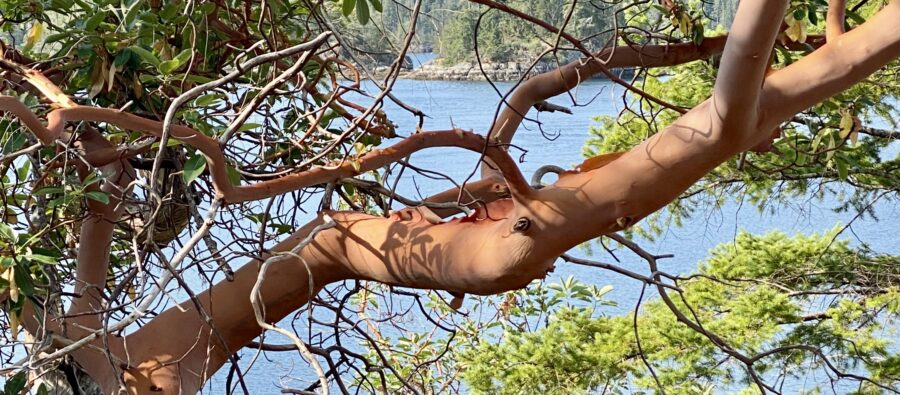
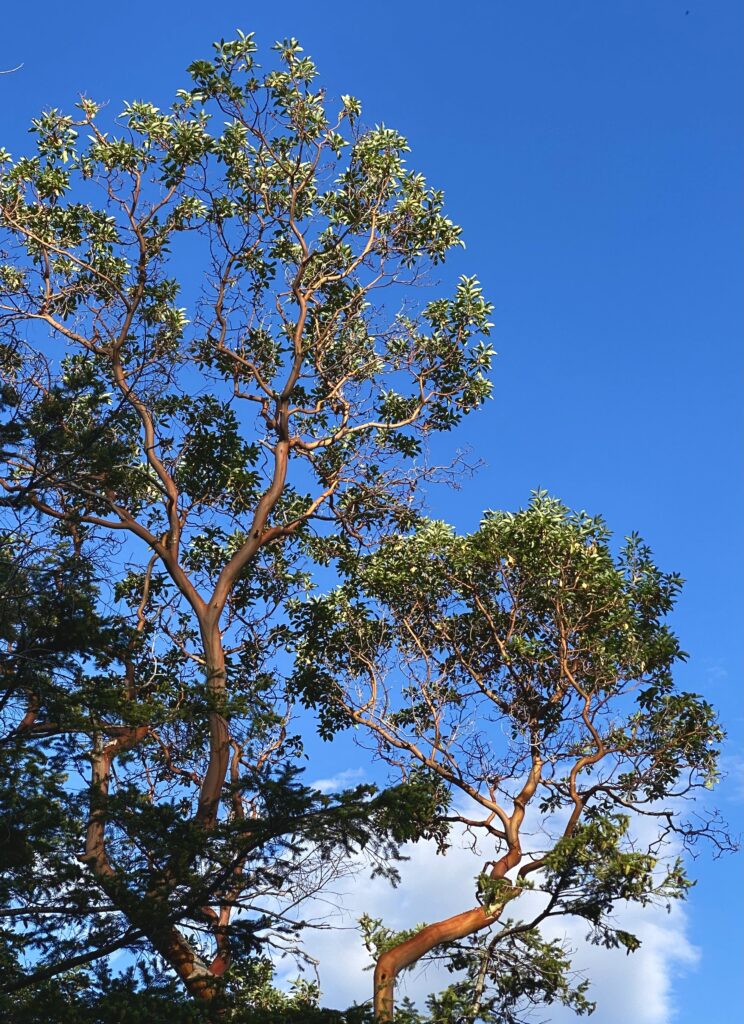
I don’t know what it is about them, but ever since the first day I visited Desolation Sound I was swept away by the arbutus trees here. Their beauty and quiet grace have cast a spell on me, and every year I learn a little bit more about them, both as individuals and as a species that are a distinctive part of the local ecology, along with associated flora like Douglas fir and hairy manzanita.
A Little Local Tree Lore
Commonly called arbutus in Canada, its scientific name, Arbutus menziesii, was given to it by botanist Frederick Traugot Pursh in 1814 after the Scottish naturalist, Archibald Menzies, who accompanied George Vancouver on his expedition in 1792. Arbutus goes by a multitude of other names as well like Pacific madrone, madrona, and madroño down south through its coastal range to Baja California.
In and around the Salish Sea, arbutus is traditionally considered sacred by local First Nations, and part of the local lore is of it helping to save the people on a mountain during a great flood in a tale similar to that of Noah. Arbutus also served many traditional uses and goes by several Indigenous names. Around Vancouver, the Sḵwx̱wú7mesh (Squamish) Nation, call arbutus lhulhuḵw’ay, pronounced (thlook-thlook-way). In hən̓q̓əmin̓əm̓ (Halkomelem), the traditional language of the səlilwətaɬ (Tsleil-Waututh) and neighboring Downriver Coast Salish nations, arbutus is called q̓a:nlhp, pronounced (q̓aan)-(lhp). Closer to Desolation Sound, the Coast Salish peoples of the Tla’amin, ƛoʔos (Klahoose), andXwémalhkwu (Homalco)Nations also hold the arbutus as sacred, and in their shared local dialect, ʔayajuθəm (Ayajuthem), they call it kʷumkʷumay.
Curious Connections
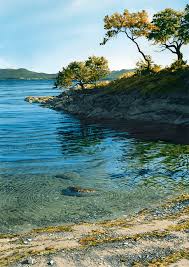
With their bright red bark and sinuous boughs, arbutus not only are evocative of trees from more tropical climes, but have a quiet sylph-like anthropomorphic presence which makes them a popular subject by west coast artists from Emily Carr to one of my favourite local BC artists, Carol Evans, who painted the above Trees on the Point.
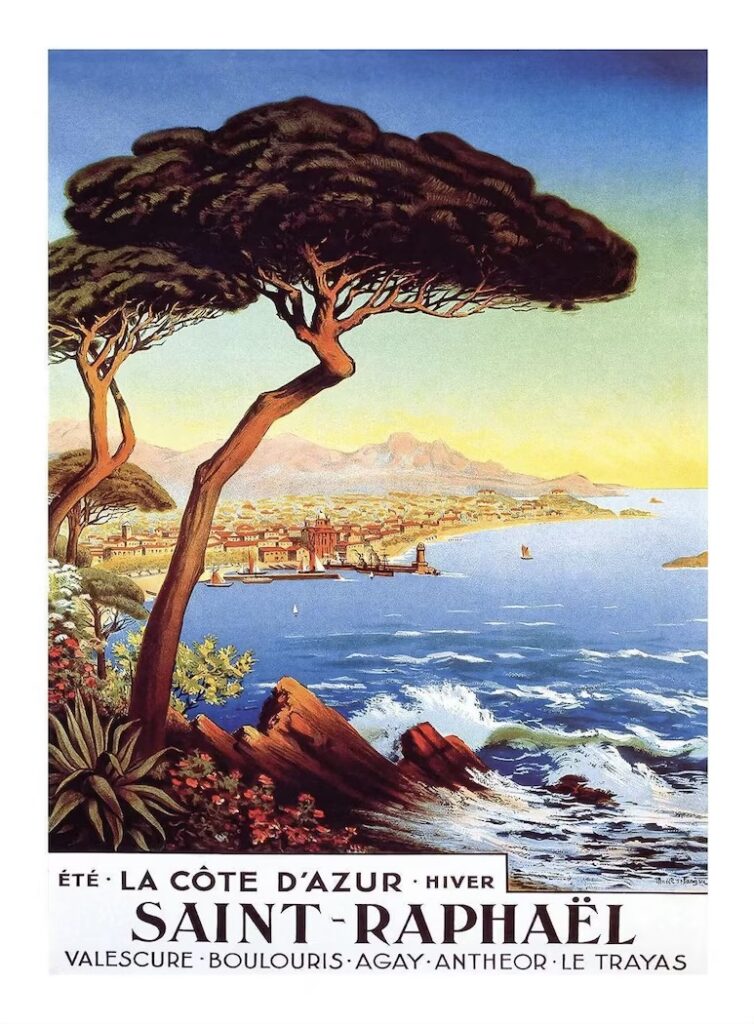
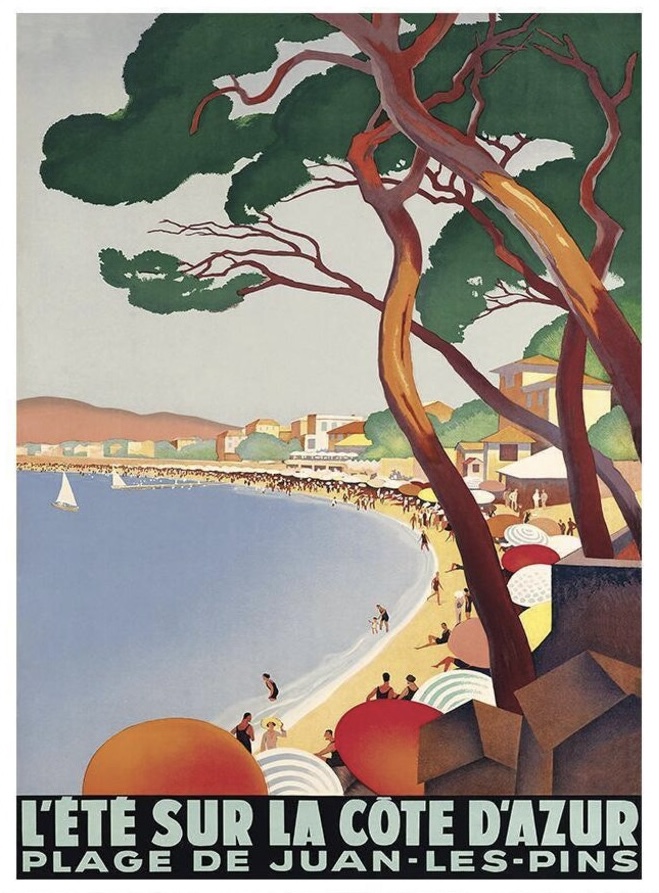
Over the last few years visiting the land, the more I looked at the arbutus lining the shore here and thought about how I might draw them myself, the more they reminded me of something I had seen before and it was pulling on the back of my mind every time I looked at them on a sunny day against the blue sky. Where had I seen images like this before? Why did they feel so familiar? And then, finally, I remembered what it was! They remind me of vintage travel posters for the south of France. As is clear in the examples below, the resemblance is uncanny!
So, of course, after seeing this similarity, I HAD to know, was there actually a relation between the arbutus growing here along the Pacific coast of North America and the mysterious similar red trunked trees favoured by artists along the Côte d’Azur? And so I set about digging around and discovered that indeed there is! The North American arbutus along the Pacific coast has two European cousins, Arbutus andrachne and Arbutus canariensis, that grow not only in the south of France, but around the Mediterranean basin, along with various hybrids. And for the plant buffs out there, these two Mediterranean species are also related to the bushy strawberry tree, Arbutus unedo, that has been cultivated in and around the Lower Mainland, and produces edible red fruit that is plump and round compared to the also less palatable berries of other arbutus species.
So, does that mean that Desolation Sound is like a version of la Côte d’Azur in the raw? If you ask me, that’s a YES (but shhh don’t tell anyone.)
A Fascinating Past
So how did arbutus trees, as anomalous as they are to other tree species in North America, get here? The answer to this question is that the common ancestors of Pacific coast arbutus and its European cousins covered a vast connected range across the northern hemisphere in a continuous belt of warm broadleaf forest from about 66-23 million years ago. Any dinosaur buffs out there might raise an eyebrow on these dates, because the origin of these tree species spreading out was right after the asteroid that wiped out the dinosaurs!
Then, around 23 million years ago the climate started to cool and dry and the land bridges connecting this expanse broke down, and the arbutus branch in what is now North America got separated from its previous homies. So, if arbutus seems like a subtropical tree it is because it is actually a survivor from an ancient lineage of actual subtropical trees that radiated across the earth after the age of the dinosaurs.
Anomalous Behaviour
There is a discrepancy here as well, however; because if arbutus is a tree with a subtropical vibe, why is it that when I look around the land right now at the cusp of summer, I see yellowing and falling leaves all around me abandoning their limbs to join the Southeasterly winds? Why is it feeling like autumn in springtime? What is happening???
As it turns out, arbutus, being the trickster tree that it is, messes with the duality of common definitions many of us learned growing up. Like, trees are either deciduous and lose their leaves, or they are evergreen, right? Well, no. At least not for arbutus. It is both! At the same time!! Now get your botany geek glasses out, because technically speaking, arbutus is classified as a broadleaf evergreen—the only broadleaf evergreen tree in Canada. This means that it retains its glossy green leaves all winter long. But it also has a deciduous phase where it drops its older leaves, and to make matters even more convoluted, instead of doing that in the fall like a normie tree, the arbutus typically sheds from June to August, while its new season leaves are growing in.
So unlike most deciduous trees we are familiar with that drop their leaves before the cold season, arbutus do most of their shedding during the early summer dry season. They also shed their old reddish-brown bark in mid summer, revealing their striking chartreuse new bark underneath, and that red papery bark also makes a relaxing tea…
What a thing it would be
to sip arbutus tea
while watching the tree
slowly slip out of the rest of its skin
by the Salish Sea.
So, right now all the arbutus around me are moving into their deciduous phase where they are starting to drop their old yellow leaves, but when you look up at the tips, you can see that indeed, they do also have bright green new foliage. Like Dylan Thomas writing above about himself as a wee lad in the poem, Fern Hill, arbutus are both green and gold… as they sing in their chains like the sea. And if that isn’t a form of sanctity in and of itself, I don’t know what is.
If there is one thing that living off grid teaches you that we can be blissfully oblivious to living on grid, it’s about power. Not the Nietzschean will to power master of the universe type power, but actual power. Energy.
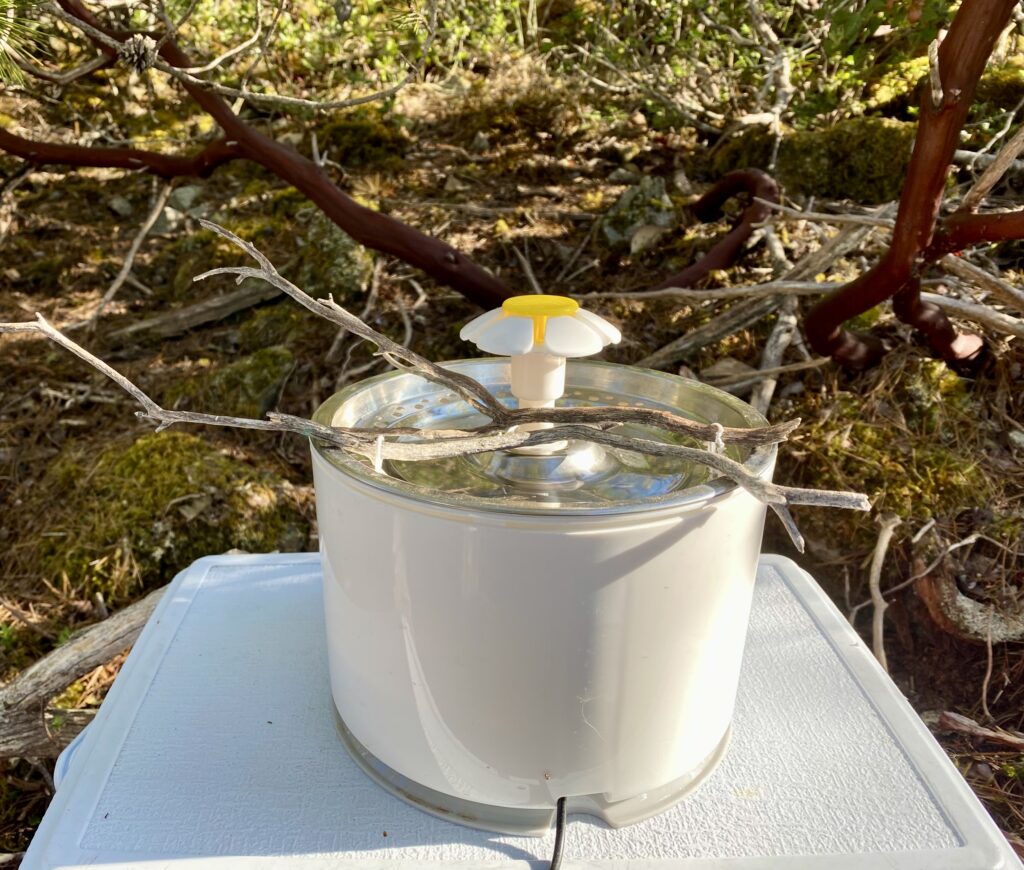
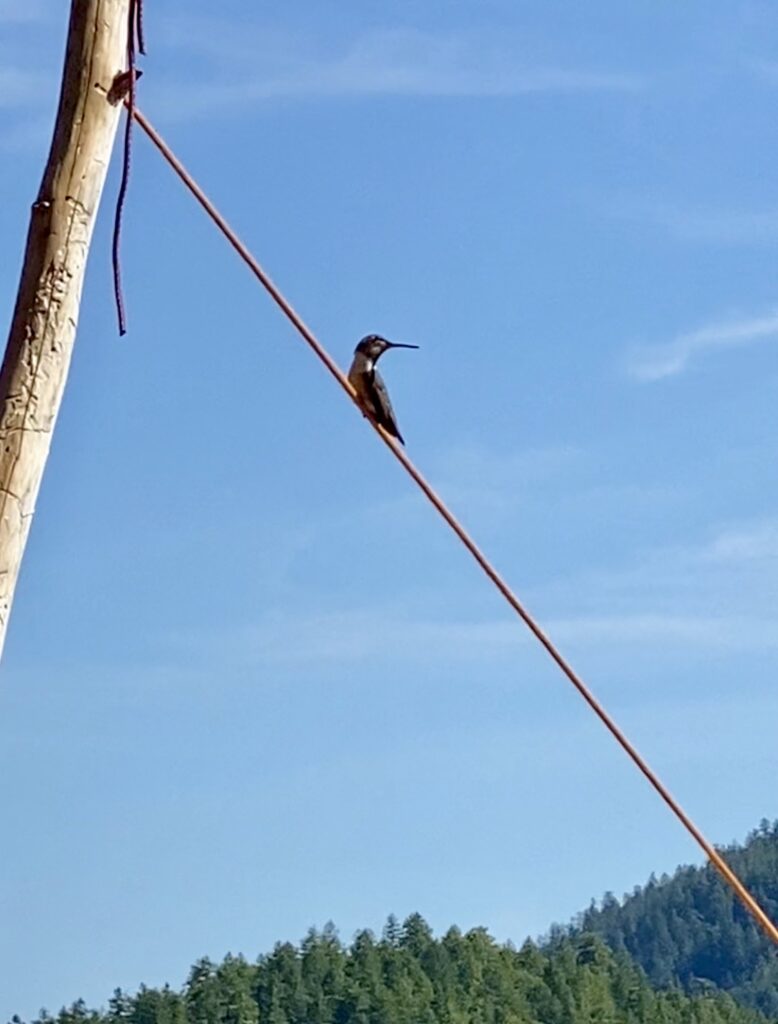
Like this rather ugly mistake of a plastic cat fountain above that I had a moment of weakness for and bought on sale, but my cats loathed and ignored and I have attempted to salvage by turning it into a hummingbird fountain to see if it might be of interest to them with the dry heat up here. I got my long suffering dh to cart this up when I met him at Scout camp back in May, and was all excited to plug this into our Jackery, which runs on solar power, and watch all the hummingbirds in the neighbourhood flock to the latest bougie bird spa in the sound. Welp, not only did the hummingbirds completely ignore it—they didn’t even sit on a branch! This innocuous looking beast actually completely drained my power bank running for a few hours!
Zero percent! So this isn’t like some of the gargantua solar setups like some of the neighbours have around here who have luxuries like four solid walls in their lives. No. It’s a Jackery Explorer 2000 V2 that can handle surge to 4400 W and ran our hammer drill just fine when we had to drill holes in the local granite bedrock. It also has been (up until now) a reliable power source for our Dometic cooler. But plug a ridiculous little water fountain into it, and you will drain its lifeblood in no time.
So it looks like the Desolacium Found Bird Spa is offline due to technical difficulties and the hummingbirds are going to have to wait some more for me to build their watery oasis of their dreams. I will look into some solar bird fountains and see what I can come up with next, but since it’s going to be raining for the next week, I think the birds will have so many options they wont need my services in the meantime. What do you think? Should the search to build the ultimate bougie biophilic hummingbird spa continue or should I drop this errant quest? Please let me know in the comments!
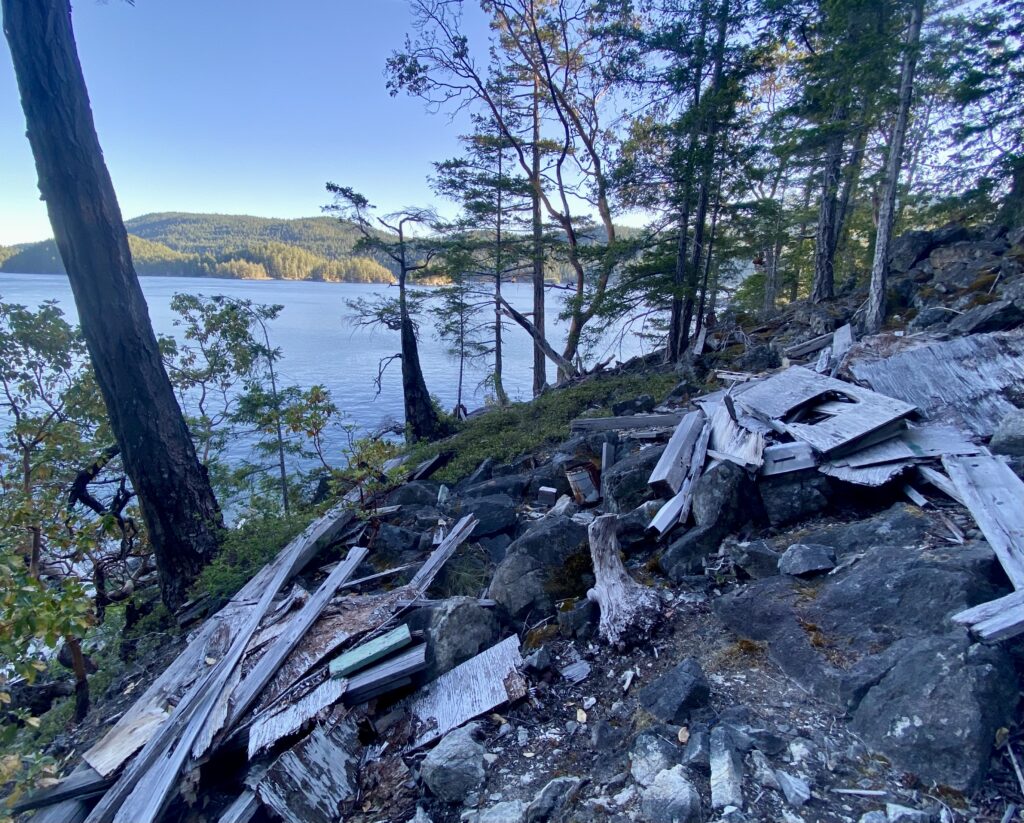
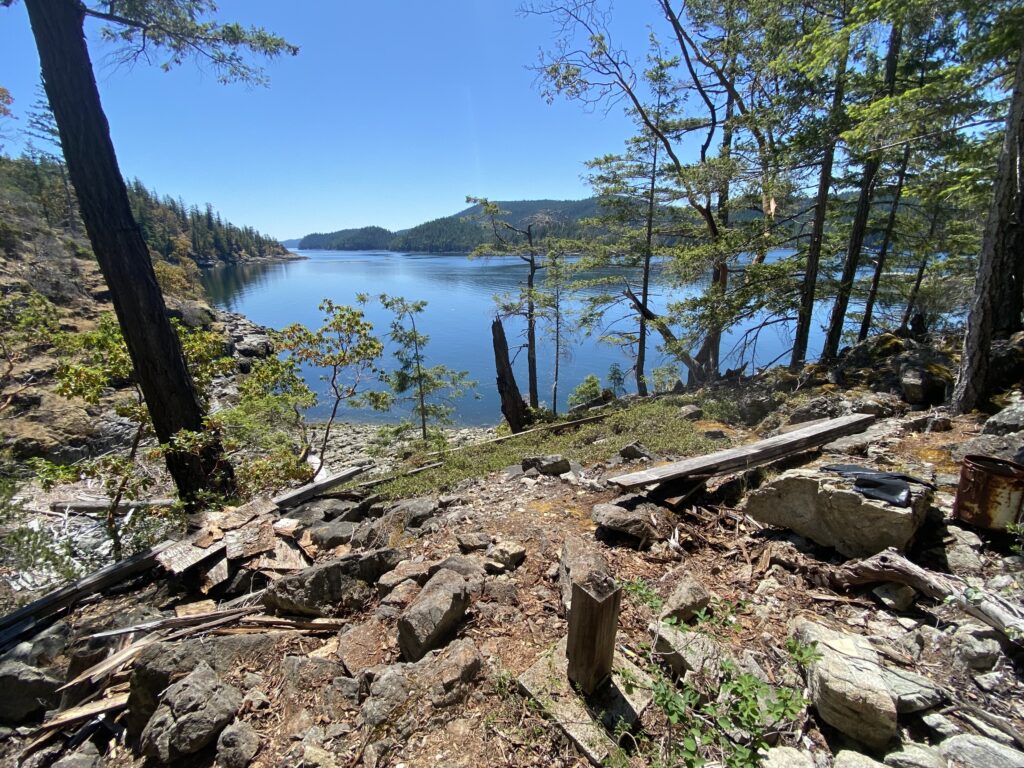
I recently learned that the people who were going to help me on my first shed build are not going to be able to do it in June like I had thought. So, I’ve been drowning my sorrows in throwing boards with a lot of nails in them around for the last couple of days on part of the site where a previous cabin was destroyed and left to rot. Here is a “before” shot of the site.
That was Sunday May 31st at 7:30 pm right before I started the job of sorting and organizing the wood, the salvage and the waste. It was up to 34°C during the day, so I decided to wait until it was cooler to do such a dirty job involving heavy lifting. The story I heard about this land is that there was someone who had built a cabin here, but someone ended up squatting on the property, so it had to be pulled down. Such a pity. Such a mess!
I worked until 10 pm and then into the next day, and had to stop when I got to the big structural beams that were feeling too heavy for me to lift on my own. So, here is the “after” picture of where I’ve managed to get it to so far.
The post on the concrete block in the foreground was completely buried in the previous picture. Earlier today I started loading the garbage on the site and the wafer board that is visible in the bottom left quadrant of the above photo into garbage bags. There is a special place in Hades for this material. It was so friable it was disintegrating in my hands as I was trying to pick it up, and sending up gnarly clouds of dust (yes I had PPE) and yet the stuff wont rot because it’s laced with industrial chems to prevent it from doing just that. So, it gets all over and contaminates everything in a situation like this where it was just left on the site for years. You can’t burn it either because is illegal as it would release toxic formaldehyde gas and dioxins. The only option is to take it to the dump. This is one of the reasons why I will try my best to avoid such products as we go into our own building phases. Full cycle cradle to cradle LCA all the way. At least to the extent that is possible. It’s a work in progress.
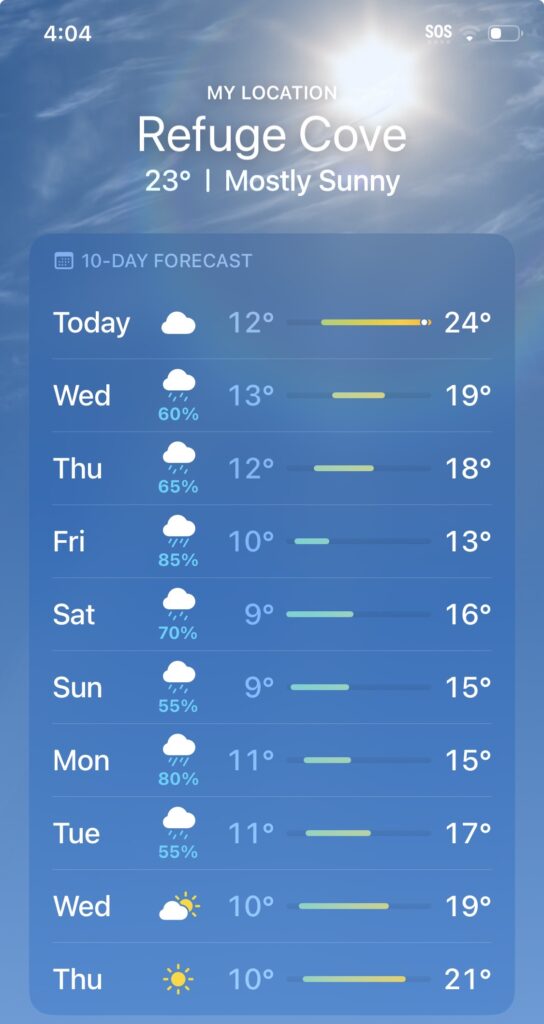
Today the wind is picking up. This is my weather forecast for the next week.
qathet weather report
I’m really in for it. A week of rain! Seven whole days! And the wind is shifting. Like in Mary Poppins, when the wind shifts around here, you know there is some kind of mischief or drama afoot. When it comes from the NW, you can chill. But when it shifts to the SE, then you’d better batten down the hatches if you are camping with tarps or else you could be in for some really nasty surprises as I have learned the hard way in the past.
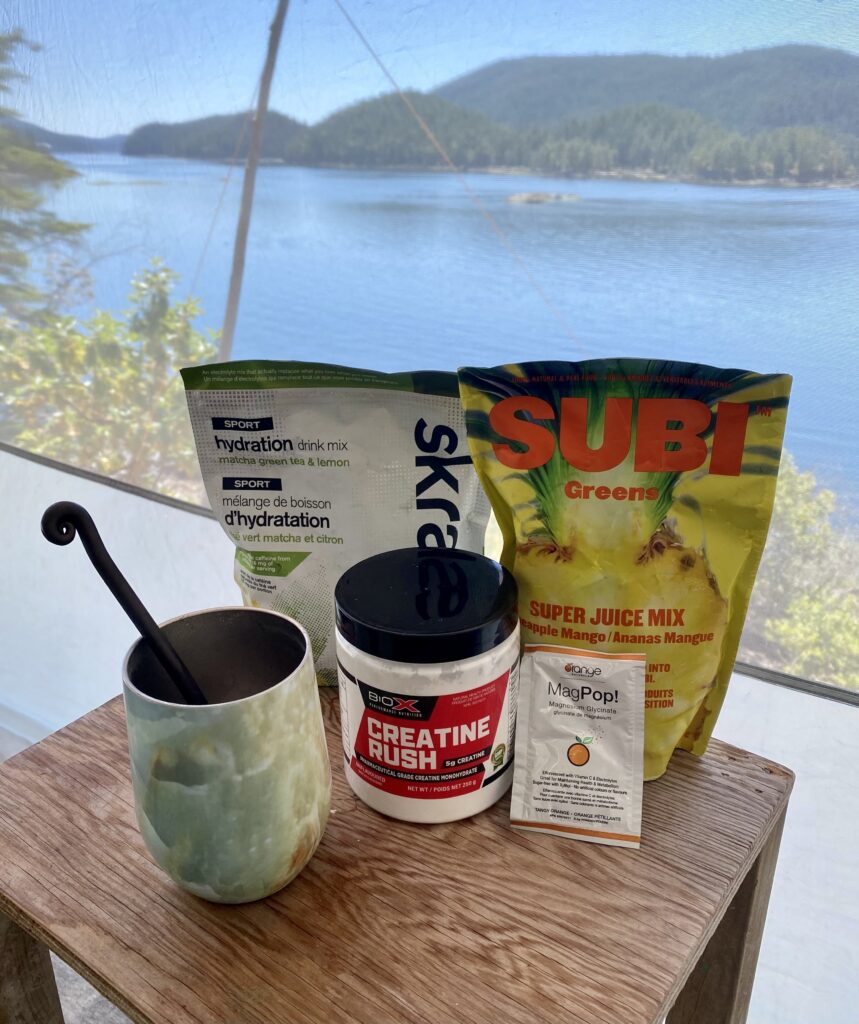
I bought some new tools that I was hoping to use up here, but power tools and rain are not a great mix either. My first thought when I woke up this morning, knowing the forecast, was maybe it was time to throw in the towel. It just wasn’t going to work out for me this trip. But then, I had my breakfast of champions below…
…(which, if you know me is very anomalous, and this is not an ad, but I picked up the creatine and the magpop in Powell River on the advice of Claude when I asked what I should get for extreme muscle soreness and fatigue lol). After that I did a walkabout on the property, and decided to try and install some tarp shelters that I could potentially use as a makeshift shop to do some work while it rains.
There is a high chance with the winds around here that this is going to be an epic failure like my episode with the “tarp dragon” when I was camping with my lo two years ago, but hopefully I learned something about what not to do from that, and I will head higher up in the trees where it is less windy to stake out my spot and start mounting the tarp after I finish this post.
When I was a child I had a strange dream. I was standing out on a pier, similar to the one at Huntington Beach in California, and there were several tourists casually milling about. Someone over by the side gasped and yelled about something in the water, and everyone, including myself, went over to look. I climbed up and leaned over the railing and looked down. The sea was a this kind of deep turquoise, milky and luminous at the same time. Through it I could see the shapes of several large forms slowly gliding through the water.
It was so amazing. So many sea creatures! So many fish! Sharks! Whales!!! I wanted to get a better look so leaned out juuust a little bit more, and then before I knew it I lost my balance (or perhaps I felt a little push?) and was falling—-right down towards the water! Panic ensued as I tumbled through the air and down down down, sploosh! Into the sea. I plunged down deep, almost to the bottom, got my bearings and then looked around. The water was this amazing azure colour with sunlight streaming through and I could see the forms of the whales going by, feeling massive, like enormous dirigibles. My panic subsided as I realized nothing was coming to eat me, and I soon realized that I must be breathing underwater since I didn’t feel like I needed to go to the surface. I started to swim upwards and towards the whales as if pulled by a magnetic draw and as I got closer I felt like they were sending me this deep feeling of peace. I felt like I belonged there and they wanted to show me something, and so I started to swim with them to wherever they would take me. And then my mother woke up and I was terribly upset with her for ruining only the best dream of my life. But luckily for me, a week, or a month, or a year later (I don’t recall now) I did have the dream again. And then again. It was one of just a few that was recurrent.
And so it was that I felt like, after many a long year of not having this dream anymore, that at 11:11 am last Saturday, when I took this video standing on the land and looking out at the Inlet, I had to pinch myself to make sure I wasn’t dreaming of swimming out to sea with the whales once more.
How many orcas do you count? It seems to me at least three? And is that a baby orca I spot with the little fin? 🥹 It would be great to know which pod this is and which individuals.
Before I say anything else, I want to note that I have a peculiar issue with posting from here as my iPad (that I am using to write this) has a scant bar of wifi, but because I take photos on my phone, I realized today they have not been syncing. So, I have very few photos on my iPad that I can use. Argh! So, I will try to resolve that tomorrow and get some more photos up…
Today reached at least 34°C! In the shade! I contemplated going for a dip in the ocean, but yesterday I spent hours out on the water untangling my buoy line (a story in itself) and re-setting up my boat pulley lines (another long story), so I felt the pull of the land more today. This morning I managed to have a shower and do a huge load of laundry by hand, so I almost feel civilized.
After the sun went down a bit I decided it was time to do some more work around here. Since it is taking us a while to determine what our bunkie and eventual more four season cabin design will be, we need at least a wee shed, shelter, shack, shop, studio structure to be able to escape the elements while we are here.I have been busy the last few days clearing a site to build said structure, and make a sketch of what that could look like, but since I have sent that to my neighbour who might help me build it, now I have a bit of extra time to do something else. So I decided it was time to clear the garbage wood on a plateau down by a gully on the land where a little cabin used to be, but was pulled down because apparently someone was squatting there back in the day. It is quite a mess of decaying lumber and particle board and littered with nails. We have already done a lot of cleaning out garbage up here and have brought at least 3 boat loads of garbage to the facility in Powell River. But I figured it was finally time to tackle the beast, and so I put on my safety glasses, leather gloves and steel toes boots left over from when my daughter went on a trip to Dominican Republic years ago, and I went over to do that around 7:30 pm.
When I got there it seemed pretty overwhelming as there was wood and waste strewn around a site at least 40 ft long, but I was determined. Banish the mess! Free the land! So I started on the debris farthest up the slope and worked my way down. I made a pile of lumber and wood that might still be salvageable that is nail free (which had like only 2 boards!), and a big pile of wood that has nails, a pile of garbage, and a pile of wood that could potentially be burned, and I managed to actually get through most of the debris strewn about the site. There was a bit left, but my back was tired and it was getting hard to work safely without setting up lights, so I finally called it in around 10:00 pm. I have some before and after pictures of the site I will share when I can.
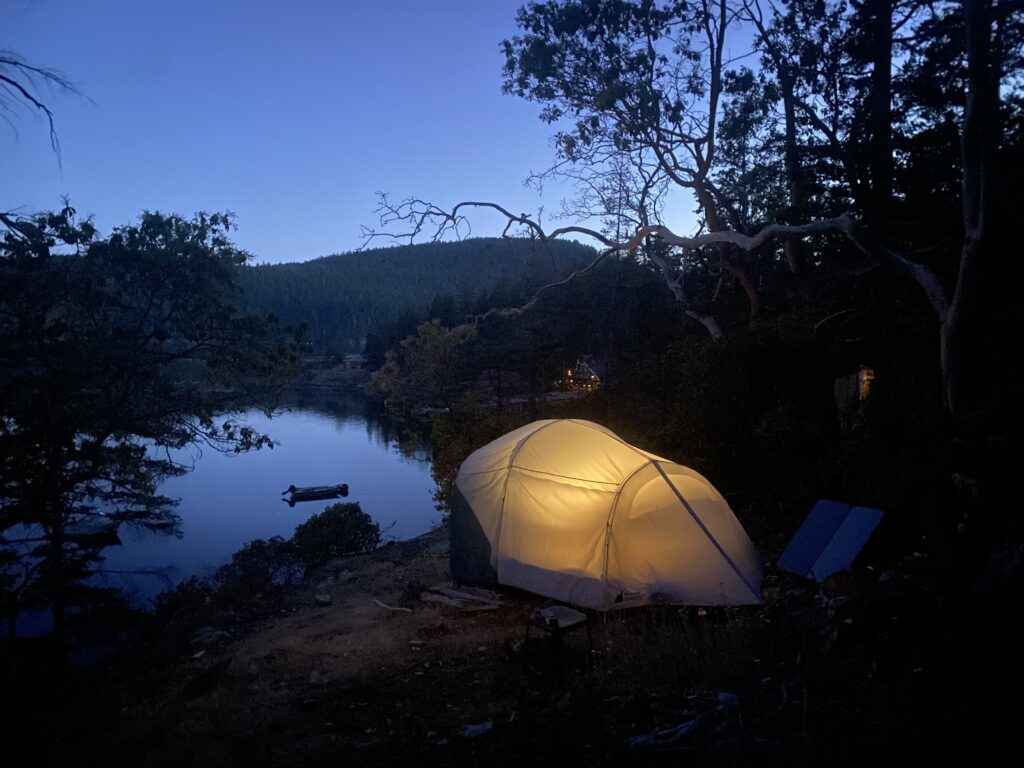
Although it can be scorching during the day, it dropped down to about 10°C again tonight. “Feels like 6” says the weather report. My tent is in two vestibules, so at night I close the central flap to help keep it a feel a bit warmer in my zone. One of the things I debated with myself before coming out this spring was whether to get one of those canvas tents that you can put a little stove into.I also pet the screen of a few camping cots that I could set up in my fantasy glamping scenario. Every night I kick myself… Or, according to family systems theory, I should say that the part of me that likes the comforts of life (Miss Comfy) kicks me that I didn’t do that. But the part of me (Miss Frugality) that descends from thrifty farm folk wanted to make the most of what we already have and save the monay for actual building. And another part of me (Miss Ecology) also reminded me that part of my design criteria for the land is to keep material waste to a minimum if I can. So those annoying bishes won out, and now grumpy Miss Comfy has to wrap in a bundle of multiple blankets and sleeping bags to be warm at night. And so I popped a chewable cherry melatonin and washed it down with some magnesium citrate water prior to coming to bed, and I lie down in this glowing orb on a cold shore, wrap the fleece blanket around me, get into my sleeping bag, pull the wool blanket on top and, in spite of my love for self debate, am half way to dreamland before I put out the light, with a smile on my face.
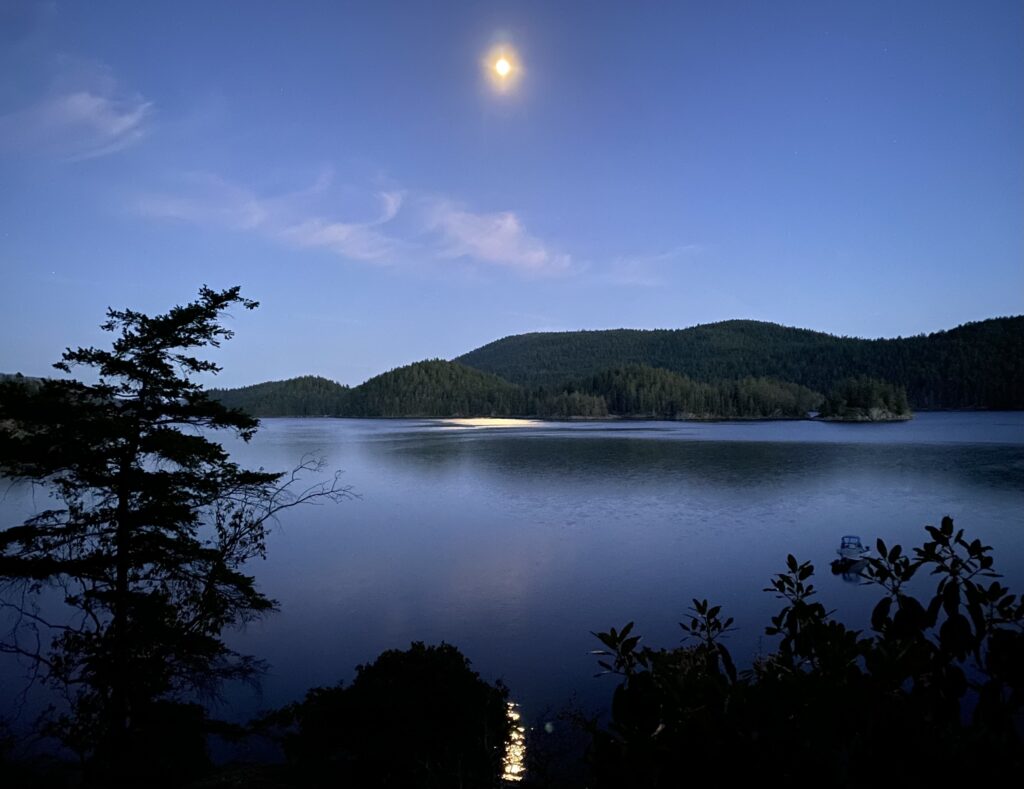
It’s 12:30 am, and I’m currently sitting in a white mesh tent with hastily strung, solar powered, yet dim LED string lights meant to look like Edison bulbs barely lighting my keyboard. It’s pitch black outside so I can’t see out past what feels like a mesh space pod, and every now and then the wind lifts a side flap or something scurries nearby and I get a lovely dose of fight or flight adrenaline.
Luckily my wonderful neighbour who has gone out of town is allowing me to use his wifi as my land has very spotty service, if any. So, I’ve been trying to revive and update this blog for the past day (well more like the past 10 years, but that’s another story) so I can get off a screen and back to this living on the land thing I’ve been doing the last couple of weeks. I managed to register and find a host, as well as import my old blog over to this platform here yesterday, but so much of it has been lost in translation, and ever since I’ve been wrestling with weird formatting and ugly fonts and other minutia to get it at least somewhat presentable. While I was sitting here just now though, it felt like something came up and nibbled or scratched my toe. Mouse? Other more dastardly creature? It’s pretty much a black vortex when I look down towards the old deck slats after staring into the glow of my iPad screen, so it could be demon claws peeking through the cracks in the firmament for all I know. So, regardless if it is mouse or ghoul, I think that is a sign the land is telling me to leave well enough alone and go over to my tent and go to bed.
So, here is my first inglorious dispatch from a dark and moonlit shore. When I said I want to tweak my fonts again, quoth the land, nevermore! (At least for tonight!)
A private person, Mary Oliver has given few interviews in her career. This, in the age of the selfie, and in spite of her winning the Pulitzer Prize, National Book award and being recognized by the New York Times as “far and away, this country’s best selling poet.”2 But I’m OK with that, because then Mary can concentrate on the more important things in life, like stopping to linger and listen—really listen—to the birds
Note that if you learn about and buy any of the books from any of the Amazon links above, this will contribute funds to help continue the work on this blog, thank-you.