Friday June 5, 2026
It’s five o’clock in the morning. Do you know where your boat is?
This is the question that seeps into my mind after I roll over to check the time. I try to go back to sleep, but that’s not about to happen now that I’m thinking about the boat. So, I roll out of my sleeping bag, unzip my tent and squint down towards the sea. The air is perfectly calm, the sea is glass, the birds are starting to serenade the day, and my boat is totally fine. Yet, it would not be hyperbole to say that I have the boat buoy blues.
It all started on Wednesday night, when I was busy preparing my camp for at least a week of inclement weather heading in. It’s not so much the rain that concerns me out here. It’s the wind. Say you put up some lovely tarps to protect your camp from the rain? Think again. I myself have observed winds out here at much lower speeds that still feel like they come galloping in like ancient storm gods from Odin’s wild hunt, trash your tarp, rip it from its grommets one by one, and then use your tarp to trash the rest of your camp as it whips around… but that story is for another day. This one is about winds and tides.
Your Math Teacher Was Right
Imagine an isosceles triangle. Can’t do it? Don’t go to Desolation Sound and get a property and a boat because…. you could die. Or lose your boat. Or just an eye. Melodrama aside, well actually, no, I kid you not.
You know when you were back in school and teacher said you better pay attention to geometry or it could come back to bite you? Or maybe you were great at geometry, but then life got busy and you low key forgot about it? Well Desolation Sound is one of those places where geometry’s grim and nefarious teeth lurk, waiting to get you. Where? They lurk in plain sight in your boat buoy rope setup.
Beware the boatbuoyropesystem my child! The jaws that bite! The clamps that catch! Beware the jowls of the tide, and shun the ropeysnatch!
(That was Lewis Carroll’s first version of The Jabberwock, I swear.)
Whatever am I swarthygroping in the mimsycoves about?
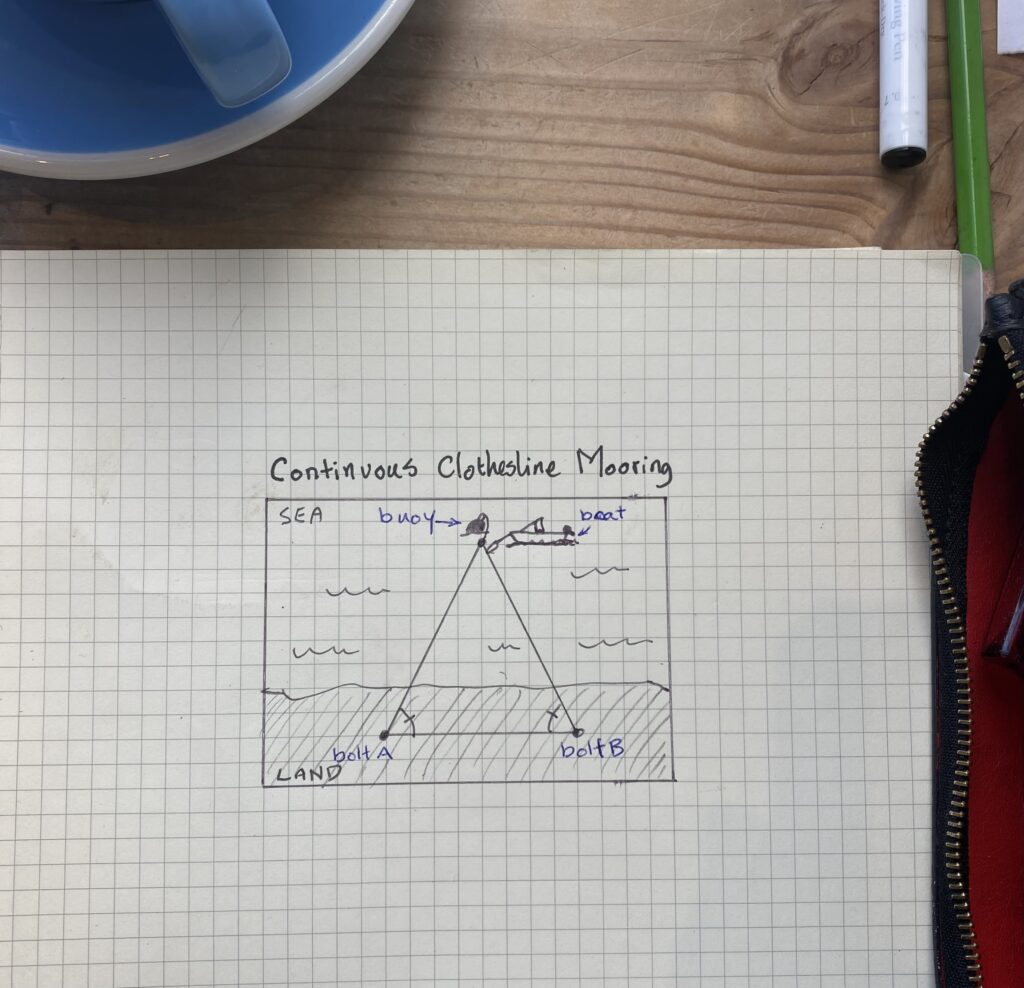
Back to our isosceles triangle. You can imagine it? Great! Now imagine the two bottom corners of the triangle are eye bolt anchors your husband (dear husband, dh) made hammer drill holes for and mounted into the bedrock. The top point of the triangle is out in the ocean—your buoy. The closest I’ve seen to a diagram of how this system works is here on this blog by Neil Moomey. So here is my own quick coffee break rendition as I sit and enjoy a few minutes in town with reliable wifi and the luxury of a lovely honey late at 32 Lakes Cafe and Bakery.
A How To Guide
This boat mooring setup is often called a “clothesline” setup or a more geeky “triple pulley boat mooring system”. It solves the problem, when all you have is a mooring buoy, of having to boat out to your boat. Instead, if all goes well, you should be able to just stand on shore and pull one rope on one side to pull your boat in and pull the other rope to send it back out to the buoy again.
Once upon a time docks were a more rare presence in Desolation Sound, and this was the going system that people used to keep their boats from being dashed upon the jagged granitic rocks that line the coasts here. But if you are not an old hand salty dawg like the folks up here and a noob at this stuff like me and my dh, there are not very many instruction guides out there for how to set up and use this system. Florida Sportsman has this Youtube video guide for the case where your land points are set into a beach. Similarly, the TheHowtoDad has a video that makes it look really easy pulling in your boat using this system on a calm day with a soft sandy beach in this video.
Let’s just say, these balmy sea bunny scenarios are NOT my use case though. While storm winds in recent years along the western shores of Vancouver Island have clocked in at 144 km/hr, here in Desolation Sound, in spite of the buffering effects of Vancouver Island and the Malaspina Peninsula, the locals inform me that the winds can similarly reach upwards of 100 km/hr, and often reach 40-65 km/hr. On the Beaufort wind scale table that covers ”near gale” through “strong gale” to “storm” categories. So, when your boat cost you your left kidney and the shore is lined with barnacle toothed boat munching rocks, you don’t want to get your mooring set up wrong. (And if it is actually going to approach Beaufort Category 7-11 conditions, many neighbours actually go and move their boats to a safer harbour or bay during that time.)
So, how do you set up a triple pulley clothesline mooring system on a rocky shore? Same in theory as the above guides, but you install your mooring buoy according to local guidelines / regs, ideally meeting and beating the buoy dead weight if you will have your boat out there in shoulder seasons. And, instead of digging into sand to mount your shore pulleys, you need to get a hammer drill and a way to cement in strong eye bolts into the bedrock at least around 20’ apart.
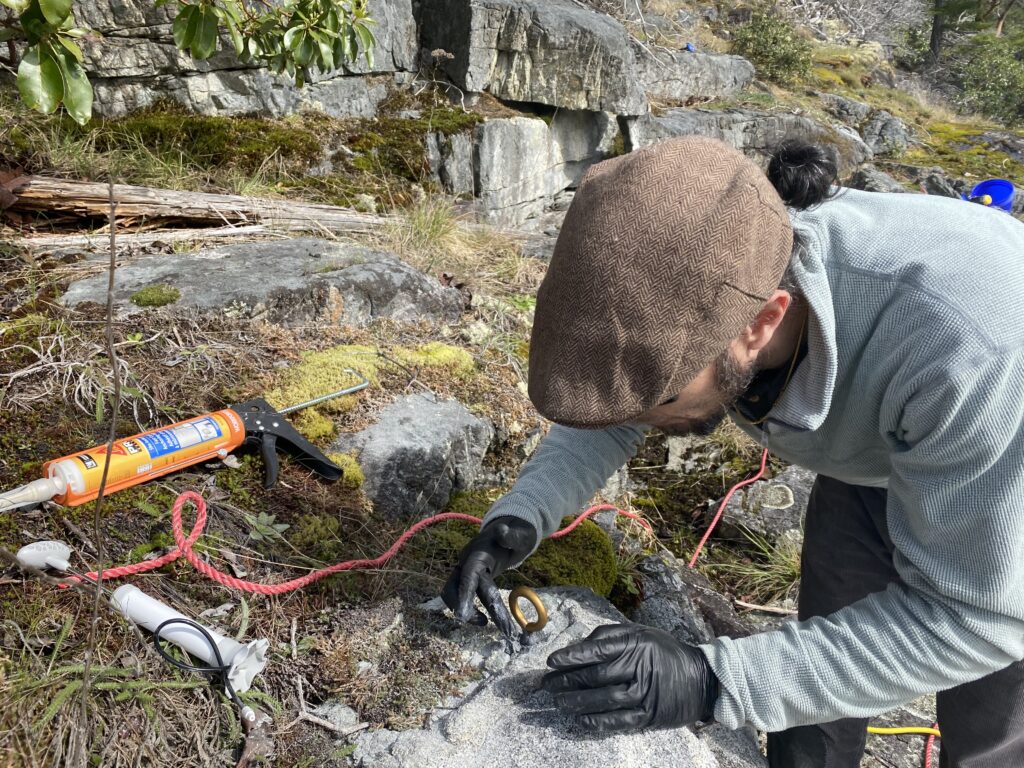
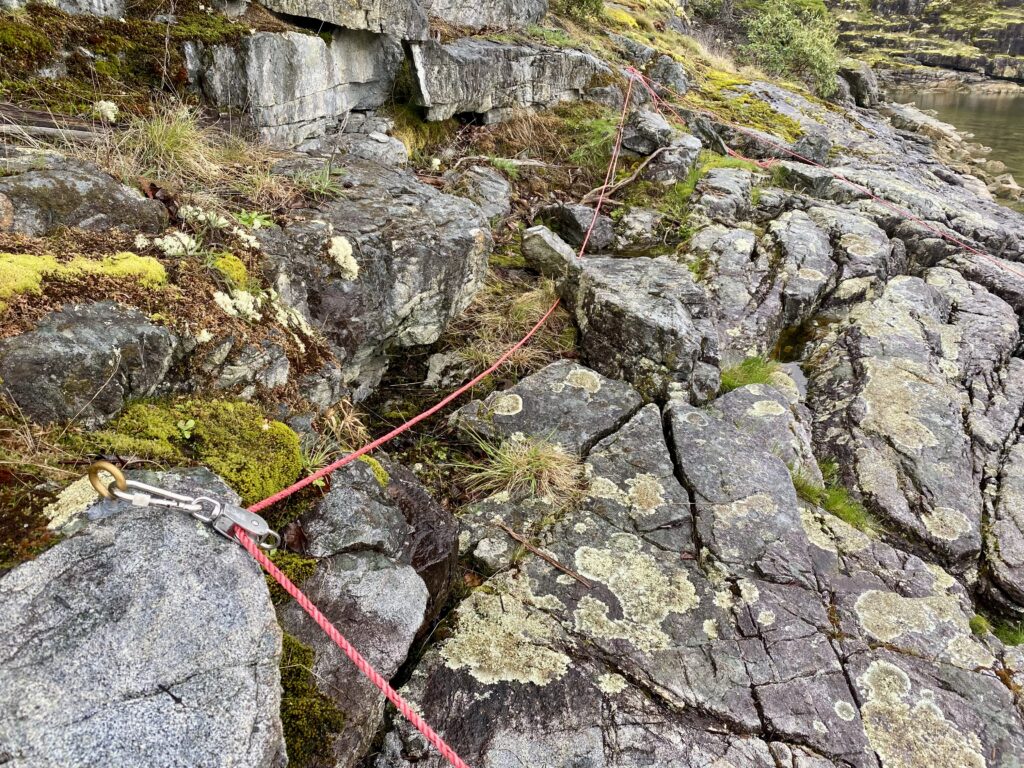
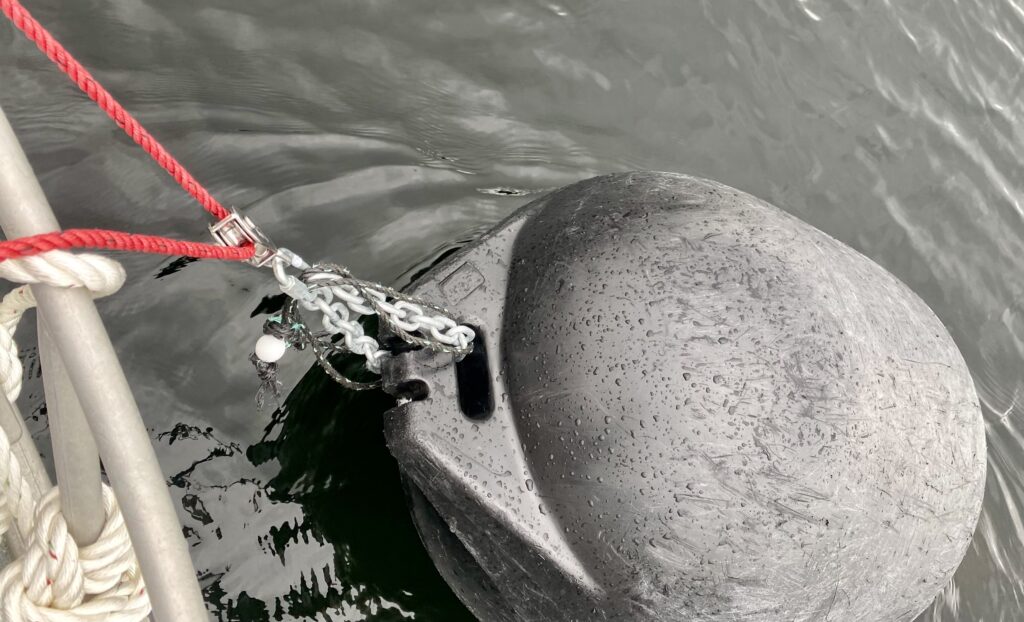
Then on each bolt, you secure a pulley and through this, connecting all three points, what many people do in these parts is string a sinking line through (so it doesn’t tangle in your propeller) and then tie it off at one of the bolts, leaving several feet of slack. (I may provide more detail on all this in a subsequent youtube video.)
A How Not to Guide
The above is the end of our seemingly simple theoretical setup. But as we all know, reality usually has other plans. It certainly had wayyy other plans for me.
One of the complications to be aware of is which side of your triangle you tie your boat up to. To do this is simple enough, you just make a loop knot on that side that you can tie a line from your bow eye to. Well, you would think it is simple from the above videos in calm conditions, but what I learned—after the wind, waves and currents picked up—is it is not.
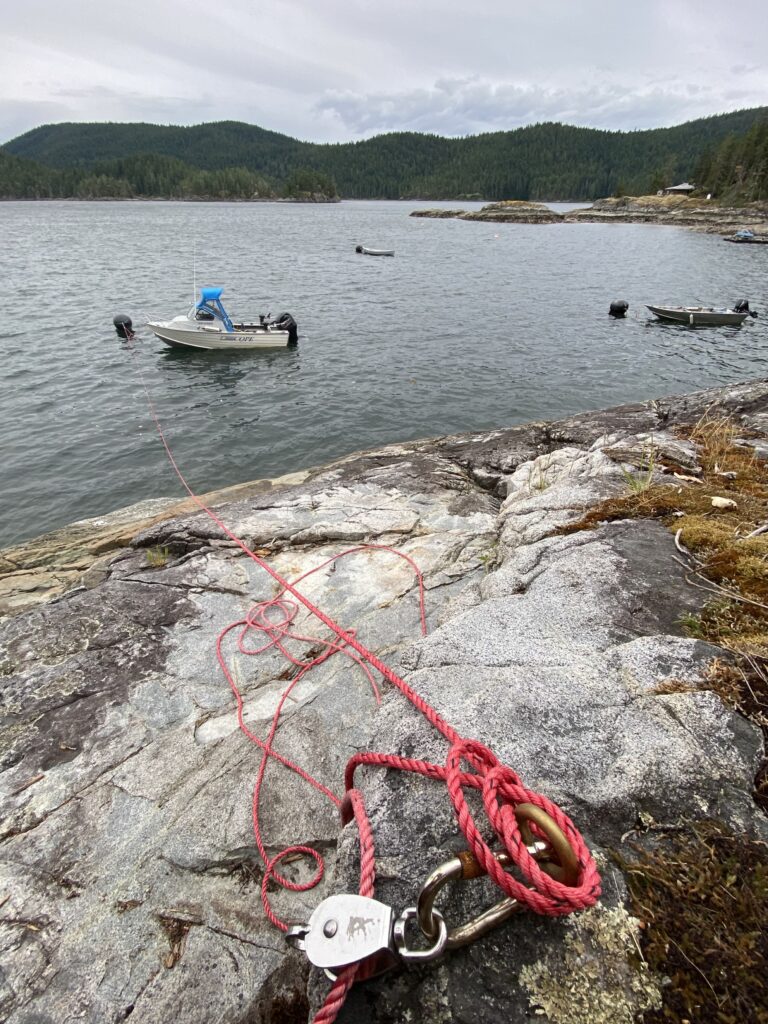
For my own measly human reasons I decided to tie my boat on the left (east) side of my clothesline triangle, and it seemed to look good after I set it up, as shown in the picture below. No twists in the lines by the buoy and my boat is positioned where I thought it would go because conditions were calm when I set this up. I arranged it to the left like this because (silly human) I thought that would keep my boat a bit farther from my neighbours’ boats that are off to the right (west). The road to hell is paved with good intentions, right?
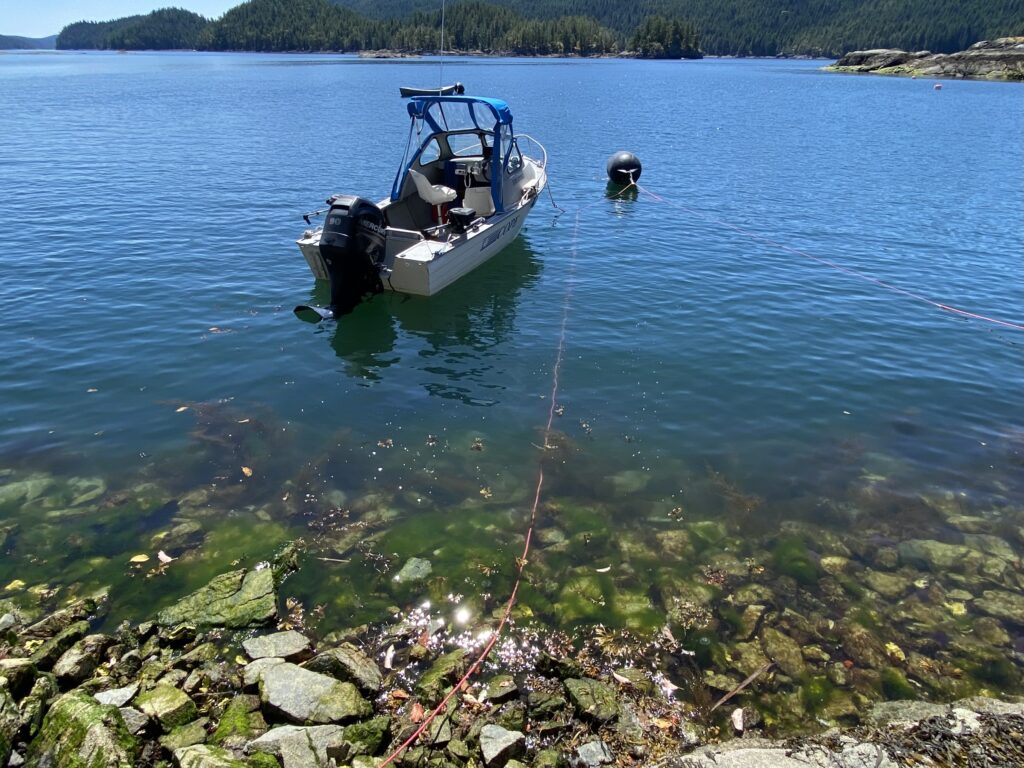
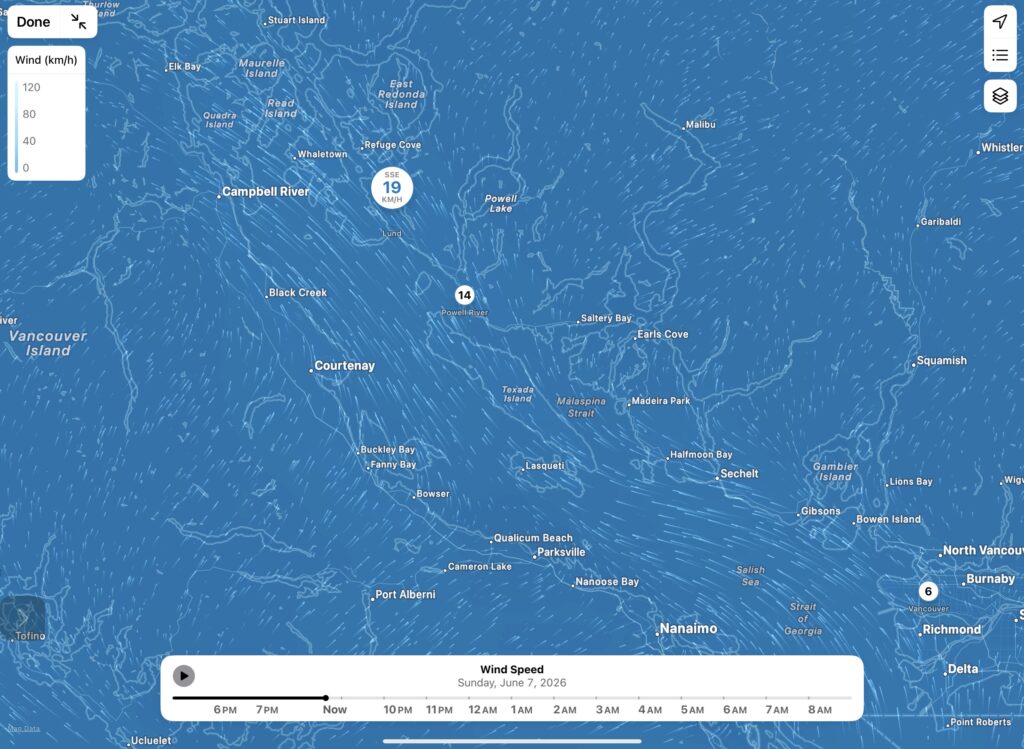
There’s nothing like the reality of the sea to fact check our best assumptions and make a mockery of our best intentions. What I realized only after I had left my boat out there for a while, and feeling proud of myself for having restrung our mooring line set up and it not twisting (again another story) was a series of lessons in humility. I had completely neglected to take into consideration the prevailing winds and currents that operate in our area. Up Okeover Inlet, and throughout the entire Salish Sea, there is a bit of a binary system most of the time. When winds are from the NW, you get calm conditions, but when that Mary Poppins wind shifts to coming from the SE, then you are in for strong winds, waves and current coming from that direction. Below is a map of the region and prevailing wind vectors showing one of these southeasterly wind scenarios where you can see all the wind vectors heading from SE up towards the NW across the Salish Sea (Georgia Strait).
Ocean doesn’t care about your polite human preferences to not have your boat encroach on the neighbours. Ocean doesn’t care that you didn’t remember geometry or local weather systems. And out here Ocean is the boss. So, you need to know what the prevailing winds/currents are in your area to pick the best side of your triangle to tie to. If you do not, you may find yourself with a boat perpetually crossing over the other side of your triangle, looking something like this below where my boat has been pushed across to the other side and you can see by the buoy how the lines are now crossed over.
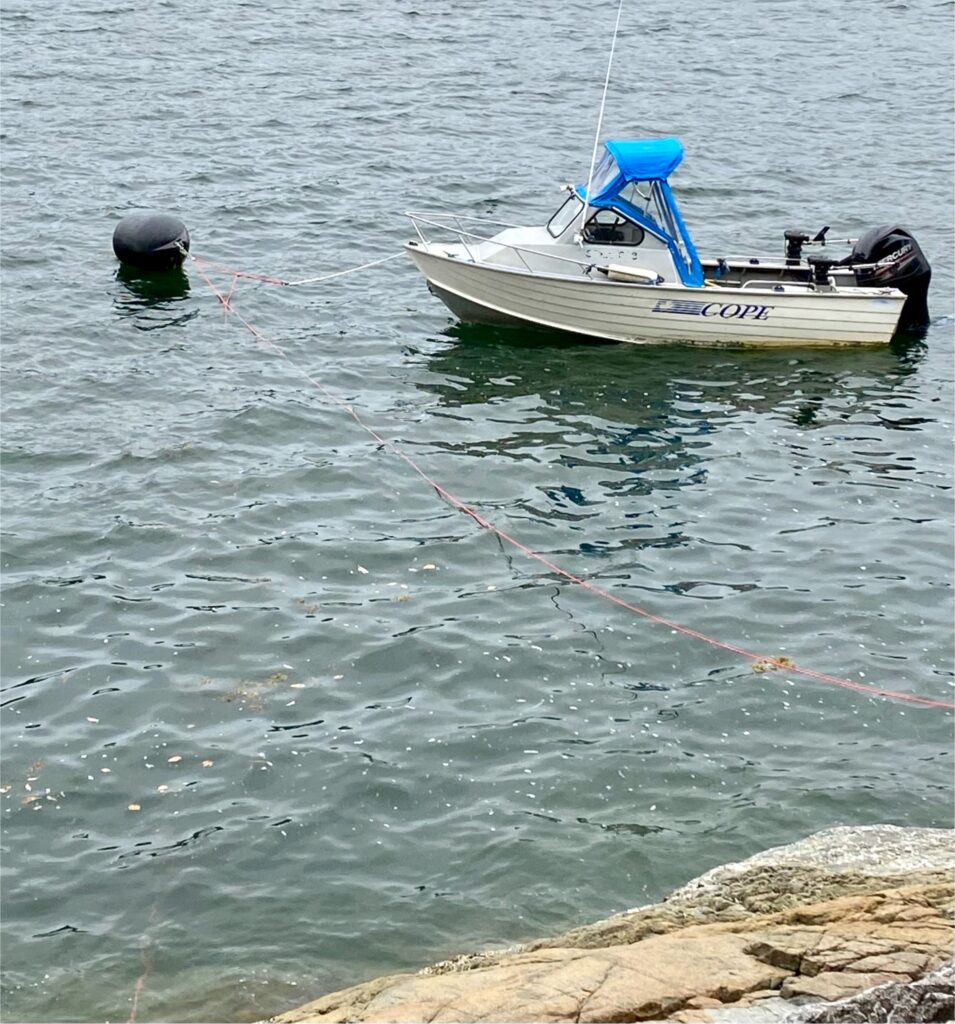
My second mistake was not tying off to the mooring line loop from my boat’s bow eye. This is a strong eye loop soldered in the bow area on the prow below the nose. My dh bought a skookum line at the local marine shop up here and it has heavy duty clamps on it, but I tied this to the mooring line loop from up on a bow cleat higher up on one side because I thought that was easier for me to access so would make my life easier, and I saw some other videos about sailboats tying to mooring buoys from up on their bow cleats. Boy, was I wrong! (My neighbour later told me to tie off to the bow eye, and I realized the error of my ways.) What ended up happening is not only did my boat wander across the other line, but because my lines were high up instead of low where the bow eye is, the lines were crossing over across the deck of my boat, and catching on all kinds of things, from the chairs, to my Scotty downriggers! Not fun watching your boat bobbing out there on the waves with the ropes all messed around, and trying to cowboy style lasso the ropes off of all your boat parts, including and especially the propeller and delicate downrigger parts. And you can’t pull it in and fix it, because the winds are high, and your boat is conceivably still safer out by the mooring buoy that pulling it into shore where the waves will instead bash the whole thing against the rocks repeatedly.
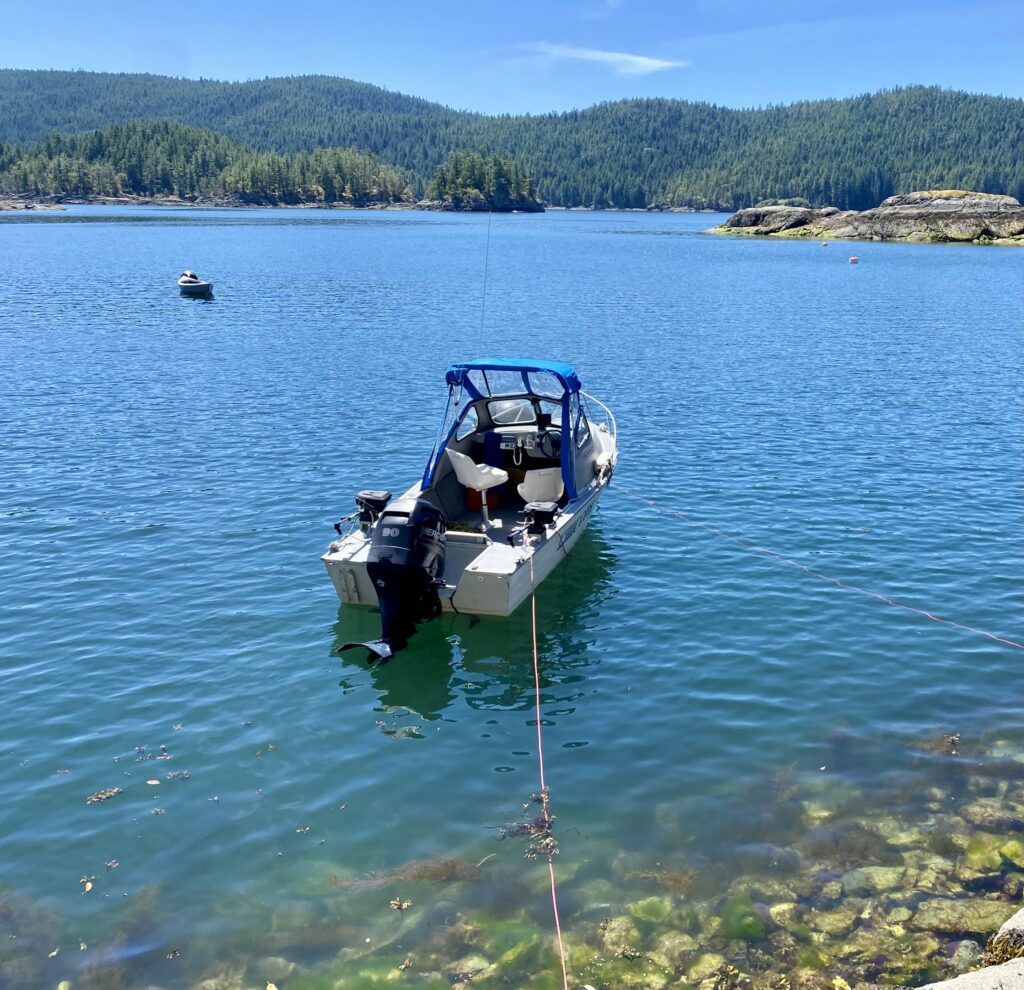
My Big Mistake.
So presuming you didn’t make my first or second mistakes, now you need to shift your thinking from 2D to 3D geometry. Can you visualize what will happen to your buoy, your boat, and your ropes, as the tide comes in and goes out? No? Then bam! You’re dead. Like I almost was Wednesday night when I made a massive miscalculation.
It all started innocently and calmly enough. I had observed how my lovely neighbour who has been operating a similar system for decades made a bit of a knot in his line after pulling on it to pull his boat out to the buoy, and then looping it loosely over the eye bolt. He said you do this so that all the slack in the rope doesn’t just go out which would allow your boat too much ability to wander far from your buoy. So I copied him. And it seemed to work, no issues, for the few times that I used it. And what else did I do? Well, I had previous issues with our setup the first time we strung it up as the two ropes from shore twisted at the buoy point (due to our rope being new and wanting to twist), which made it it impossible to yank on the rope and pull the boat back in. That was extremely aggravating for my dh and I as we pulled it out, took out the loops in the rope and tried to straighten it several times before we finally got frustrated and took out the lines altogether.
So, this time I thought it would be a good idea to keep the ropes on either side fairly tight to keep the ropes pulled apart so that they wouldn’t have enough slack to twist around again. But in my general exhaustion from dealing with tarps and wind and everything else that I was going through, I didn’t think about how the tide was going to affect the length of rope needed to reach the buoy. And what I happened to do was tie up my boat at low tide, not thinking about what would happen as the tide rose…
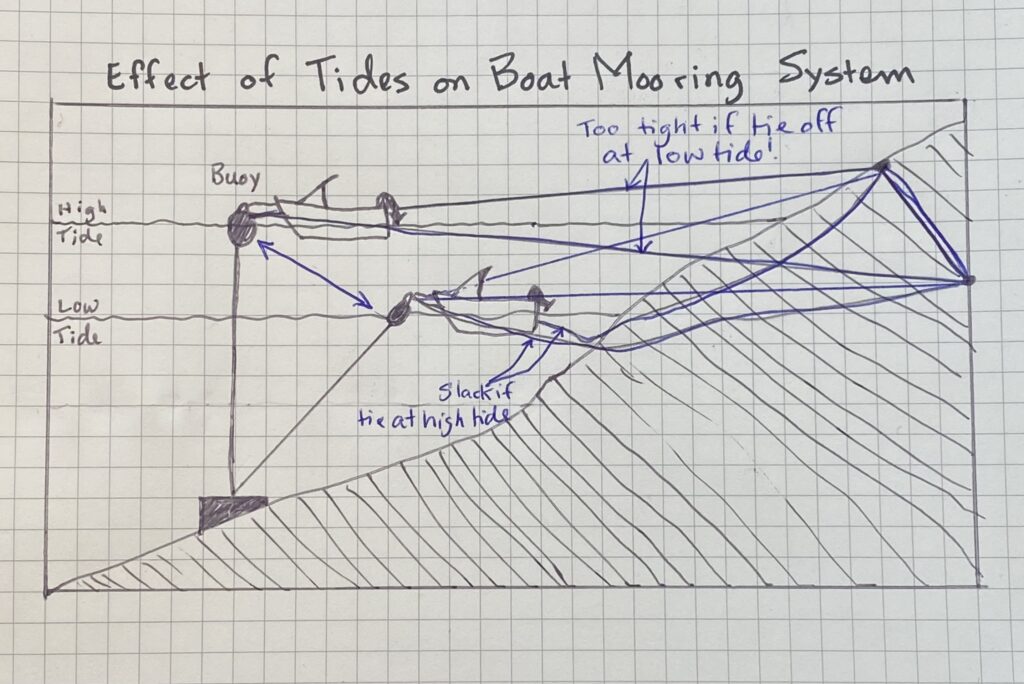
So back to our geometry review. As shown in my sketch above (sorry I only had two colours so it isn’t the clearest), what happens to the two lines of your triangle is at low tide the buoy has more freedom to swing around and can come in closer to shore, but at high tide, it is lifted straight up above its anchor. The tide does not negotiate on this. It doesn’t care if you tied off at low water and wandered off to deal with other priorities. So, in this situation, you need to be aware of what the tides are doing when you arrive with your boat and go to tie it off on shore. If it is high tide, the buoy is farthest from shore, so the lines are stretched out longer on your triangle than if you arrive at low tide.
But what did I do? I tied up my boat at low tide and I did the little knot loop to secure my ropes over both eye bolts as mentioned to prevent the lines twisting like they had done previously. Then, instead of keeping an eye on my boat and lines like a seasoned deckhand would, I got busy and distracted working on other issues in my camp. Inclement weather was rolling in and I was running around taking down some tarps and setting up others and trying to ensure that items that didn’t take kindly to getting soaked were tucked away for when the predicted rain and wind rolled in.
So then what happened? Well, the tide did what tides do. The tide went up. And up. And up…
At some point, I was all the way up at my space net location way up on a bluff, trying to string my tarp across it thinking maybe I could make a tarp room sheltered from the winds for when the rains came. I was struggling setting up our 20’ x 40’ tarp across this and trying to string up a ridge line through the middle of it. While I was working, I started hearing a clinking and clanking noise on my boat that I normally don’t hear, but I looked out at my boat and it looked OK so I kept working. Well, that sound was the clamps on the mooring line I had strung to the bow cleats banging on the boat. Not a good situation. I knew it wasn’t cool and that I had messed that up, and thought to myself that now I would now have more scratches on the paint on my second hand boat than I had before, but I figured it wasn’t dire and I could fix it when the winds dies down again. But then, there was just something about the ongoing sound of the resonating clanking sounds that kicked in some peculiar intuition in me and I had a weird feeling of danger. So, trusting my gut, I decided I better drop my current tarp predicament and go and check on the boat. Thank goodness I did that, because that’s when I discovered The Situation.
The Situation
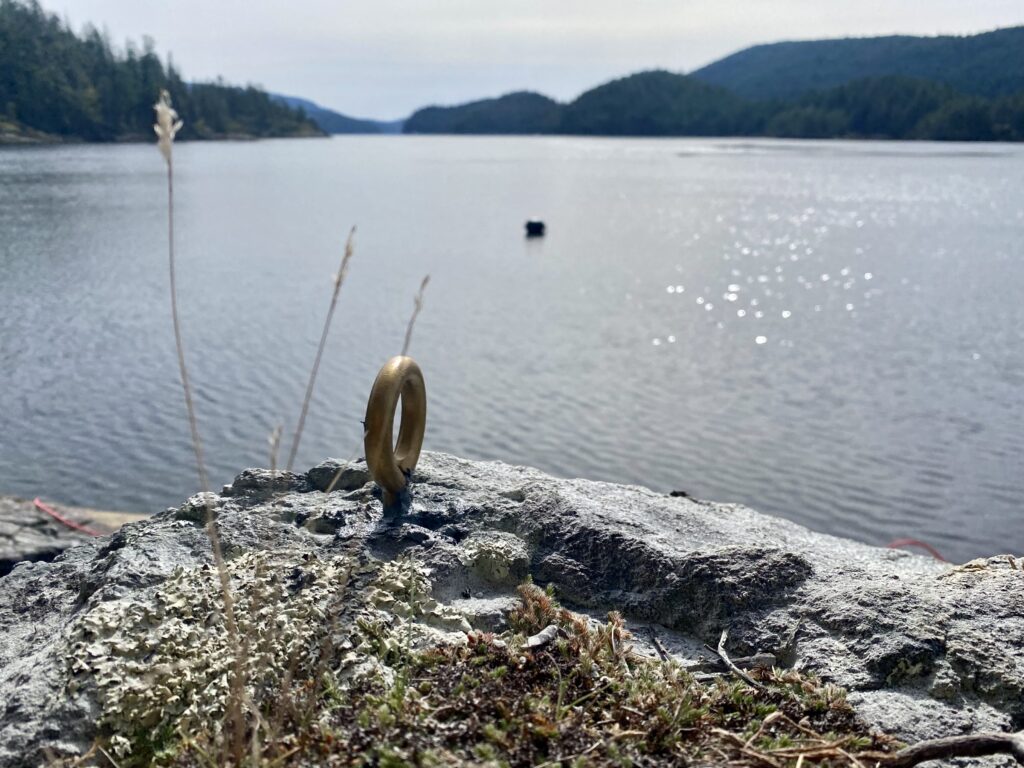
I hiked down from the bluff and arrived on shore to a scenario I had never witnessed before and hope to never have to deal with again. What had happened was that the loops that I had put over the eye bolts had been pulled SO very tight that it was impossible for me to lift those loops back up over the circle of the eye bolt. I pulled on those ropes with all of my might, but I could not budge them. Not at all. Not one bit. And my adrenaline was rapidly mounting as I imagined scenarios where one of the anchor bolts got ripped out and took with it a part of my anatomy with it or embedded in my face or thigh, or some other wholly unpleasant outcome.
I sprung into emergency management mode that my training as a lifeguard back in the day instilled in me. Forget myself and DEAL. What did The Situation require to solve it? Pulling on the ropes like a maniac and exhausting and injuring myself in the process had not worked (you do not want to know about all the bruises). I needed to get smart, so I figured I need to use some sort of leverage to at least get one side off to give some more slack to the whole system. So then, I tried to use the big carabiner that was also on the eyebolt to lift it up to push the rope up and off. However, the way the rope was tied and the angles of the carabiner made it so that I could lift up one side of the rope or the other side, but I couldn’t get the part of the rope over the thicker diameter of the circular hole in the eye, as the rope was pulling at the base of the eye bolt as though the Leviathan itself was pulling on the other end.
I knew I could cut the lines, but I imagined it would spring out and thoughts of being whipped or impaled were not at all appealing, so I thought, Ok, I’m a human. Humans use tools. Tools got me into this situation. I needed better tools to get me out. At that point I thought about the little tool kit up near my tent that my dh had left me. I ran back up the bluff and grabbed it and found in there a strong looking larger Phillips screwdriver and a small crowbar. I was really worried that if I deployed these and managed to lever the rope over the eye bolt, that if I had one of those tools at the wrong angle when that happened that the rope would catch on this piece of metal and perhaps I would be faced with the losing a finger or an eye type hazard again. I had to risk it though, so I looked down at the tight knot I needed to deal with very carefully and figured out a way to proceed. I would use the screwdriver to lift up the rope sufficiently on one side and use the crowbar at the back to lift the rope upwards over that wider circumference of the eye screw. Then, hopefully the force vectors would pull the rope away from the back of the eye bolt towards the sea, so the crowbar would hopefully not catch and just fall back on the ground.
So at this point I was already exhausted from struggling with pulling on the ropes earlier and sprinting up and down the bluff, but I put on my safety goggles and started working on it, to try trying hard not to think of a scenario where the crowbar flew into them and embedded itself and my goggles into my eye. After struggling for a very long time and digging my knees into the granite rock and getting completely filthy dirty on the ground, trying to maneuver the screwdriver and crowbar repeatedly, I finally managed to release one of the sides! When it happened the line snapped back out towards the buoy like a bat out of hell. I ducked and blocked my face with my arms, and when I looked up again I was amazed that it had actually worked. Yes, the tools did fly a bit, but my calculations prevailed this time, and I still had all my digits and facial features.
I would have cried of happiness for having succeeded, but the side I had released was the one with the boat loop on the east side, and it was the other west side that now was bearing all the force of holding a too short rope with a buoy pulling at it with all the force of the sea. However, exhausted as I was, I was encouraged that my method had worked, and so I went over to the other side, gathered up all my remaining adrenaline, and after another very long and ugly struggle, managed to release the rope from the other side as well. Being so very strung tight, it sprung back with such a crazy force that I have never witnessed before in my life. And hope to never again.
Last Words
So here I am now on a calm and sunny day writing the last words of this blog post instead of someone else reciting the last words of my eulogy over my dearly departed self. So all you noob boaters out there who might be thinking of setting up triangle mooring systems please please please be warned and take this as a public safety message to learn from my mistakes, and never ever do what I did at home kids. Secure your line at high tide if you are going to walk away for a bit, and if it is low tide, monitor the situation with your ropes every couple of hours. It doesn’t matter if your line is new and annoyingly might twist. It doesn’t matter if high tide is at two o’clock in the morning. This is British Columbia and I am a mom, and “safety first” is wired into our Canadian identity. So, if you are tying off at lower tide also always leave a little extra slack in your lines for the tide to come up, because you know, life happens, and we are also the distracted generation. It is just not worth it to risk The Situation that happened to me.
But that isn’t all. If that is the shot, here is the chaser. If you leave too much slack in your rope when you tie it off, the other risk is at low tide your boat could wander too close to shore, and during high wind situations… Bam! Your boat is dead. Smashed on the rocks. But, at least you are intact and not dead instead. As ever in life, when it comes to boat ropes and the tides, it’s all about balance.
So when my family checked in with me after The Situation was over, I joked that I didn’t get a crowbar embedded in my eye or lose a finger that day, so it was going pretty good. And we all had a chuckle.
Such a me thing to do. Making silly mom jokes all the time. But really, it’s ok crew, I’ve really been doing fine… When I signed up for this I didn’t think it was going to be something approaching marines boot camp training, but if that is what it takes to connect to what living on the land means out here, then sign me up. Again and again. While I hope Ocean will go softer on me going forward, I’ll go through all the hazing she has to dole out for this goal, so I’m not ready to throw in the towel yet.I have learned the ropes the hard way on this one, but one of the lessons I’ve seen is that the ropes themselves are your life line out here, so I’ll be paying them more attention and care going forward.